
Bass Harbor Head Lighthouse
Bass Harbor Head Light stands on a granite ledge at the southwest corner of Mount Desert Island, the only Acadia lighthouse you can reach by car. Parking, viewing areas, steps and photography.
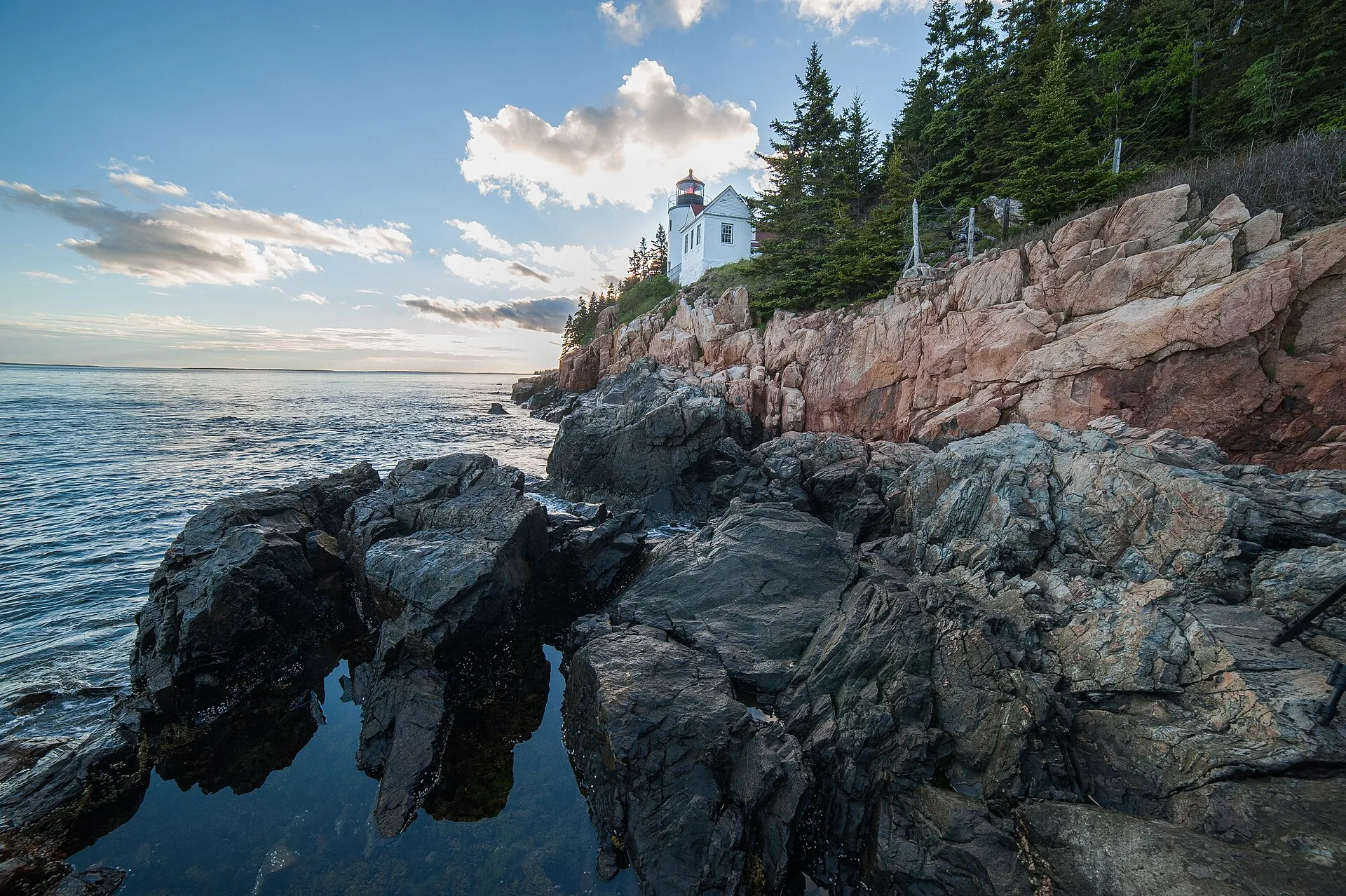
Bass Harbor Head Lighthouse clings to a granite ledge at the southwest corner of Mount Desert Island, its white tower and red-roofed keeper’s house framed by dark spruce and the blue Atlantic beyond. The National Park Service calls it one of Acadia’s most photographed and beloved historic landmarks, and it is widely described as the most photographed lighthouse in Maine, though nobody publishes a count. What the park does publish is the traffic: roughly 180,000 visitors a year, the busiest place on the west side of Mount Desert Island and the fifth busiest destination in the whole park, behind only Cadillac Mountain, Jordan Pond, Sand Beach and Thunder Hole.
Unlike lighthouses that stand on flat ground or sandy points, Bass Harbor Head seems to grow from the rock itself. To photograph it properly, you follow a gravel path and a flight of wooden and stone steps down to the shoreline and look up at the tower rising above the surf-carved granite. The composition is natural, inevitable, iconic.
The lighthouse sits within Acadia National Park, on the island’s “quiet side”. Away from Bar Harbor’s bustle, in a working fishing village that feels closer to the Maine that existed before tourism transformed the coast. Of Maine’s roughly 80 lighthouses it is one of only three managed by Acadia, alongside Baker Island and Bear Island, and the only one visitors can drive to.
The Lighthouse
History
Congress appropriated the funds for Bass Harbor Head Light Station in 1858, and the station was built that year to guide vessels into Bass Harbor and Blue Hill Bay. The National Park Service puts the tower at 37 feet tall including the lightning rod. Because it stands on a bold rock ledge, the light itself shows 56 feet above the water, the figure NOAA gives in Coast Pilot 1.
Key dates:
- 1858: Tower and keeper’s dwelling built with funds appropriated by Congress
- 1901: Present lantern, holding a fourth-order Fresnel lens
- 1902: Oil house added
- 1905: Barn added
- 1974: Light automated
- 1988: Listed on the National Register of Historic Places
- 1937 and 2020: The Park Service bought the surrounding 52 acres in 1937 and took ownership of the light station itself on 8 July 2020
- 2020: Coast Guard fitted a red LED in place of the white lamp
- Present: Still an active aid to navigation, maintained by the Coast Guard
The station also has a brick bell house that once carried the fog bell. Its date is not settled: the Park Service gives 1897, while the 1987 National Register nomination prepared by the Maine Historic Preservation Commission says it was erected in 1876. We have not seen a source that resolves the two, so no year is given here.
The Tower and Buildings
The tower is circular brick, painted white, and 37 feet tall to the top of the lightning rod. Attached to it by a narrow covered passage is the original 1858 keeper’s dwelling, a one-and-a-half-story frame house with a red roof. The covered walkway sheltered keepers who once made nighttime trips to tend the light in all weather. A bell house, an oil house and a barn stand nearby, five historic buildings in all on 2.5 acres.
The light: The 1901 lantern holds a fourth-order Fresnel lens. It is no longer lit by an oil lamp: shortly after the 2020 transfer the Coast Guard replaced the white lamp with a red LED, which let them remove the red acrylic “chimney” that had been fitted around the lens to color the beam. The characteristic is a plain occulting red, four seconds lit and one second dark, with no white sector. The Coast Guard Light List carries it as number 2335, “Oc R 4s”, range 13 nautical miles, structure “White tower connected to dwelling”.
Note: There is no public access to the interior of the tower or the keeper’s house, but the grounds and the viewing areas are open. The keeper’s house is not Coast Guard housing. The General Services Administration transferred the whole station from the Coast Guard to Acadia National Park on 8 July 2020 under the National Historic Lighthouse Preservation Act, and the Coast Guard kept only a right of way to operate and maintain the light.
Viewing the Lighthouse
The park maintains three viewing areas, and the lighthouse is best seen from the lowest of them, down on the rocks.
Accessible Overlook: A packed gravel viewing area directly in front of the accessible parking spaces, with views of the lighthouse and the coastline.
Lighthouse View: A steep paved driveway leading to the lighthouse and an interpretive wayside exhibit.
Cliff Viewpoint: A short gravel path, then a wooden staircase of 37 steps and 27 wide stone steps, down to the shoreline. This is where the classic photograph is taken, looking up at the lighthouse with surf in the foreground and spruce framing the tower.
Visiting Bass Harbor Head
Location
The light station is in the town of Tremont, at the southwest corner of Mount Desert Island, above the village of Bass Harbor.
Address: The Park Service does not publish a street number for the station. It signs the location as Lighthouse Road, off Maine Route 102A, and gives the parking area as 44.222568, -68.337273 on its directions page. Travel sites circulate a house number on Lighthouse Road that we could not confirm against the park or the town, so it is not repeated here.
By car: Take Maine Route 102A from Bass Harbor or Seawall, then turn onto Lighthouse Road and follow it to the parking lot. Coming from Southwest Harbor, continue south on Route 102 through town, then turn onto Route 102A.
Drive time: The Park Service reckons the light station at about 35 minutes from the Hulls Cove Visitor Center on the Bar Harbor side of the island, and about 10 minutes from Seawall Campground, both without traffic or the queue for parking.
Buses, trailers and RVs are not permitted, because the entrance road is narrow and the lot is small. There is no public transportation to the site.
Access and Parking
Parking lot: A single small lot at the end of Lighthouse Road with 27 spaces, plus restrooms. The park warns that open spaces may exist only during the day and to expect gridlock around sunset.
If the lot is full: Do not park on the road. Roadside parking is prohibited along both Lighthouse Road and Route 102A. Return at a less busy time.
National Park Pass: An Acadia park pass, or any other valid National Park Service pass, is required to park here. It is required year round at Acadia locations, not only in summer. Display it on your dashboard. A 7-day vehicle pass is $35, or $20 per person on foot or bike, and an Acadia annual pass is $70. If you are not a US resident, the park charges an additional $100 per person aged 16 and over unless you enter on an Annual or America the Beautiful pass, so the annual pass is usually the cheaper option for overseas visitors. Current rates are on the park’s fees page.
No reservation is needed for the light station. The only timed vehicle reservation in Acadia is for the Cadillac Summit Road.
Getting to the View
From the parking lot, a packed gravel overlook gives the first view, and a steep paved driveway leads down to the lighthouse itself and its wayside exhibit. For the view from below, a short gravel path leads to a wooden staircase and then stone steps down to the shore.
Stairs: 37 wooden steps, then 27 wide stone steps, and the same back up. They can be slippery when wet.
Rocks at the base: Large granite boulders. Natural, uneven surface. Use caution, especially when wet from spray.
Accessibility: Three designated accessible parking spaces sit near the entrance to the viewing area, and from them a wheelchair-accessible packed gravel overlook gives views of the lighthouse and the coastline. There is an accessible restroom at the end of the parking lot. The staircase and the rocks below are not accessible.
Hours
Acadia is open year round and there is no separate admission charge for the light station beyond the park pass needed to park. The park does not publish gate hours for the site, so check the park page before an early or late visit.
Photography
The Iconic Shot
The most famous view of Bass Harbor Head Light is captured from the shoreline rocks at the foot of the stone steps, looking back up at the station. The composition includes:
- The lighthouse and keeper’s house above
- Granite ledge and spruce trees
- Boulders in the foreground
- Ocean and sky behind
Best Conditions
Sunset: The park’s own guidance is that photographers gather here at sunset, and the light on the tower at the end of the day is the reason. It is also when the lot is worst.
Blue hour: The minutes after sunset (or before sunrise) create atmospheric images with balanced light.
Stormy weather: Dramatic skies and crashing surf add power to the image. Use caution in these conditions.
Low tide: Exposes more of the rocks in the foreground.
Technical Tips
- Tripod essential for sunset/blue hour shots
- Wide-angle lens (24-35mm) for the classic composition
- Telephoto lens for details and different perspectives
- Polarizing filter reduces glare on wet rocks
- Arrive early to claim your spot. Photographers line up for prime position at sunset
Crowding
At sunset during peak season, the rocks below the lighthouse can be crowded with photographers jostling for position. This is not an exaggeration, and it is not only our view: the Park Service heads its own visitor guidance for the site “Expect Sunset Gridlock, Lack of Parking”, and notes that open spaces in the 27-space lot may exist only during the day.
Strategies:
- Arrive well before sunset if you want a spot on the rocks
- Visit on weekdays rather than weekends
- Come in shoulder season (May, September, October)
- Consider early morning, which is far quieter than the sunset crowd
- Explore alternative angles rather than competing for the classic spot
The Quiet Side
Bass Harbor and Tremont
Bass Harbor Head sits on Mount Desert Island’s “quiet side”. The western portion of the island that sees fewer visitors than Bar Harbor and the Park Loop Road. The character here is different: working harbors, year-round communities, lobster boats rather than tourist boats.
Bass Harbor: A genuine fishing village with a working waterfront. Not curated for visitors; authentic because of it.
Tremont: The town that takes in the villages of Bass Harbor, Bernard and Seal Cove. Small museums, nature preserves, and backroad exploring.
Nearby Attractions
Wonderland Trail A 1.4-mile round trip along an old gravel fire road through coastal forest to the shore, with views of offshore islands. The park allows 30 to 60 minutes for it. It is not an accessible trail and the footing is uneven in places, and there is no toilet at the trailhead. Off Route 102A, 3.1 miles along after you turn off Route 102 south of Southwest Harbor.
Ship Harbor Trail A figure-eight trail covering 1.3 miles, through spruce woods and along a narrow cove. Good for families and birders, with common loons, eiders and great blue herons about. The first loop is ADA compliant; the second is mostly flat with occasional log-framed steps and plank trail. Vault toilets at the trailhead are not accessible.
Seawall Picnic Area On Seawall Road, opposite the Seawall Campground entrance. Picnic tables, restrooms and parking beside a storm-built cobble seawall, with tidepooling along the shore.
Bernard The village across Bass Harbor on the west side, with fish and lobster wharves and a boatyard. Bass Harbor village itself is on the east shore.
Seal Cove Auto Museum At 1414 Tremont Road in the village of Seal Cove, further north along the island’s west side and a separate village from Bernard. More than 60 vehicles and motorcycles from 1895 to the early 1920s, plus period clothing and accessories. Open daily 10am to 5pm from 1 May to 31 October, and by appointment on Mondays and Tuesdays the rest of the year. Adult admission $10, $8 for seniors, military, veterans and first responders, free under 18.
Dining
Thurston’s Lobster Pound (9 Thurston Road, Bernard): Awning-covered dining rooms on a dock over the harbor, lobsters straight off the wharf. Open Memorial Day weekend through mid October. A local institution.
Seafood Ketch (47 Shore Road, Bass Harbor): Casual restaurant on the Bass Harbor waterfront, family owned since 1984. Seafood and American standards.
Note that Bass Harbor is also the Maine State Ferry Service terminal for Swan’s Island and Frenchboro, at 45 Granville Road, which is a separate spot on the harbor from either restaurant.
Seasonal Considerations
Summer (June-August)
Peak season. Longest days mean more flexible timing for sunset. Parking lot fills early. Expect crowds at prime photography times.
Fall (September-October)
Thinning crowds. Beautiful light. Foliage frames the lighthouse. Coastal Maine turns late, so the color here arrives well after the mountains inland.
Spring (April-May)
Variable weather. Fewer visitors. Light can be extraordinary. Some services may not yet be open.
Winter (December-March)
The lighthouse is beautiful in snow. Stairs may be icy or uncleared. Very few visitors, but conditions require caution.
Practical Information
What to Bring
- Camera and tripod (if photographing)
- Acadia National Park pass
- Comfortable shoes with good grip
- Layers (ocean air is cool even in summer)
- Patience (especially at sunset)
What to Know
- The interior is not open for tours. The grounds and viewing areas are
- Parking is limited to 27 spaces, and roadside parking is prohibited
- No buses, trailers or RVs, and no public transportation to the site
- Stairs are required for the best views: 37 wooden, then 27 stone
- Rocks can be slippery. Watch your step
- Tides matter, low tide exposes more foreground
Combining with Other Acadia Sites
The Park Service puts the light station about 35 minutes from the Hulls Cove Visitor Center on the Bar Harbor side, traffic and parking queues aside. A full day on the quiet side might include:
Morning: Bass Harbor Head (beat the crowds), Wonderland Trail Lunch: Thurston’s Lobster Pound Afternoon: Ship Harbor Trail, Seawall Evening: Return to Bass Harbor Head for sunset
The Experience
The stairs descend through spruce and the lighthouse disappears above the trees. You hear the ocean before you see it, the rhythmic wash against granite, the occasional heavier crash when a larger wave arrives.
You emerge onto the boulders. The rocks are round, massive, tumbled by centuries of surf into smooth forms. You pick your way across them, angling for position. Other visitors do the same, everyone seeking their version of the view.
And then you look up. The lighthouse rises from the ledge as if it had always been there, as if the rock grew the tower the way it grew the spruce. The keeper’s house with its red roof. The covered walkway. The light that has marked the entrance to Bass Harbor and Blue Hill Bay since 1858.
The sun drops toward the horizon. The tower glows. The water turns gold. You take the photograph that everyone takes, from roughly the same angle as everyone else, and yet it feels like your own discovery. That’s the magic of Bass Harbor Head. A view so perfect it survives being shared with the 180,000 people who come each year.
Bass Harbor Head Lighthouse rewards the effort. The drive to the quiet side, the competition for parking, the stairs down to the rocks. None of it matters when you stand on that boulder beach and look up at one of the most beautiful lighthouse settings on the Atlantic coast.