
Coastal Maine Botanical Gardens: Tickets, Trolls & Tips
Plan your Coastal Maine Botanical Gardens visit: admission tickets, giant trolls, walking routes, accessibility, and separate Gardens Aglow information.
Updated
Spread across more than 325 acres of rocky shorefront in Boothbay, the Coastal Maine Botanical Gardens (CMBG) has grown from a local dream into New England’s largest botanical garden. Only about 17 of those acres are planted gardens. The rest is woodland, trail, and nearly a mile of tidal saltwater frontage. Since opening in 2007, it has become one of Maine’s most visited attractions, drawing more than 300,000 guests a year from across the United States and more than 60 foreign countries.
What makes CMBG different from traditional botanical gardens is how it embraces rather than fights the Maine environment. Mossy forests, granite ledges, and tidal shoreline provide the backdrop for carefully designed garden spaces. The result feels less like a formal garden and more like a curated celebration of the Maine coast, native plants alongside cultivated specimens, wild areas transitioning seamlessly into manicured beds.
Plan Your Garden Visit
Start with tickets and practical information, then choose between the giant trolls, garden highlights, and the shoreland trail. Read the visiting tips for help planning your route. Looking for the lights instead? Go directly to Gardens Aglow, which has its own seasonal visit information.
The History
The gardens began in 1991, when a small group of Midcoast residents set out to build a world-class public garden on 148 acres of rocky coastal forest. The founders put up their own homes as collateral. After sixteen years of planning and fundraising, the Gardens opened in the summer of 2007. The growth since then has been remarkable. What started as a few developed acres has expanded to include major garden installations, a world-class children’s garden, and the now-famous troll sculptures.
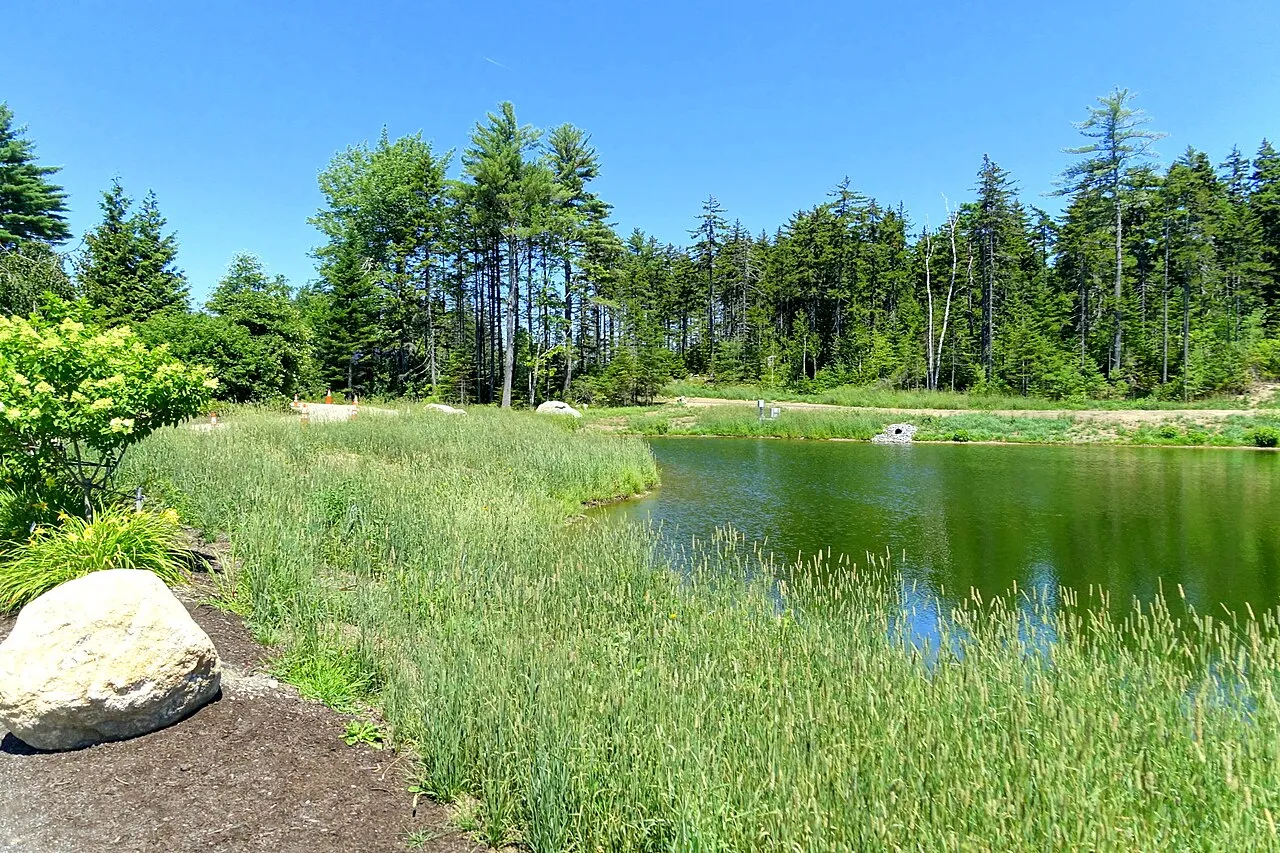 The planting sits inside the rocky coastal forest rather than replacing it, which is the character of the whole site. Photo by Daderot via Wikimedia Commons, released under CC0.

The Giant Trolls
“Guardians of the Seeds,” an installation by Danish artist Thomas Dambo, has become as famous as the gardens themselves. The five giant sculptures are still on site. The Gardens does not call them permanent, but says it hopes to keep them “for many, many years,” with the caveat that they are made of recycled wood and live outdoors in Maine year round.
- Meet the Trolls: Roskva, Lilja, Birk, Gro, and Søren are hidden through the wooded trails. The heads, hands, and feet were built in Dambo’s Denmark studio and shipped over in a container; the bodies were assembled on site by a crew of ten plus more than 150 local volunteers and staff, over roughly two months. They are built mainly from recycled pallets and salvaged wood, with some material from the property itself: Birk’s hair came from the roots of downed trees on site, and Roskva’s and Gro’s fur is oak bark left over from milling salvaged logs.
- The Troll Hunt: No extra ticket is needed. General admission covers it, and a Guardians of the Seeds Map and Guide is handed out at the front desk. Do not expect to find all five in a short visit. The first troll is in the central gardens, the rest sit roughly half a mile apart in the woods, and seeing all five is about a three-mile hike over paths that are sometimes steep and unimproved. Adding the hidden seeds is another two miles round trip. The Gardens’ own estimates: one or two trolls in 45 minutes, three in 90 minutes, all five in 2.5 to 3 hours, all five plus the seeds in 4 to 5 hours.
- The Message: Each troll guards seeds and represents themes of conservation and protecting nature. The installation turns a garden visit into an interactive story about environmental stewardship.
- They Hibernate: The trolls are off limits from October 31 to May 1 each year, so a late-autumn or winter trip will not include the troll hunt. The exception is Gardens Aglow, where Roskva and her baby sister Lilja join the light display.
Please do not climb on them. The Gardens asks visitors to hug and photograph the trolls but not to climb.
Key Gardens to Explore
1. The Bibby and Harold Alfond Children’s Garden
Opened in July 2010, this two-acre garden of woods, ponds, and theme spaces was designed by landscape architect Herb Schaal and takes its cues from children’s books by Maine authors, among them Robert McCloskey’s Blueberries for Sal and Burt Dow, Deep-Water Man, Chris Van Dusen’s Down to the Sea with Mr. Magee, and E.B. White’s Charlotte’s Web. Features include a learning garden, greenhouse, chicken coop, story barn, play cottage, pond, treehouse, and maze lawn. In summer there are daily activities, from chicken feeding and storytime to puppet shows and the July and August fairy festivities.
2. The Lerner Garden of the Five Senses
Opened in June 2009 and under an acre in size, with winding paths through five nodes, one per sense. The olfactory node is planted with fragrant herbs and flowers, the taste node with edible fruits, vegetables, and flowers, and the tactile node begins at a reflexology labyrinth. It was built for universal access: changes in the brick paving guide visually impaired visitors while keeping a smooth surface and gentle slope for wheeled mobility aids, and the raised beds in the horticultural therapy area have cutaways for gardeners in wheelchairs.
3. The Vayo Meditation Garden
A quiet retreat on the shore, begun in 2005. Every piece of its stone had to be hauled down the hillside by hand. At its center sits a large basin carved by Plymouth, Maine sculptor David Holmes from a boulder of Ellsworth schist, a soapstone-like rock found in a blueberry field near Mount Desert Island.
4. The Native Butterfly House
Opened June 1, 2018, a 2,160 square-foot Gothic-style hoop house planted to support the whole life cycle of moths and butterflies native to Maine and New England. Expect mourning cloaks, American ladies, painted ladies, red admirals, black swallowtails, and monarchs, plus Luna, Polyphemus, and cecropia moths. Note: Seasonal.
5. The Great Lawn
Worth knowing because it is often confused with the children’s garden: Whale Rock, the massive Bucksport schist formation children climb, sits at the southern edge of the Great Lawn, not in the Alfond Children’s Garden. The lawn is organically maintained and open for walking, playing, and picnicking.
Gardens Aglow (Winter)
After the regular season closes, the gardens transform into Gardens Aglow, one of Maine’s signature holiday experiences. The 2026 to 2027 edition, themed “Gathered In Maine,” runs November 14 through January 2, Thursday to Sunday plus selected extra dates in late December, 4 to 9 p.m. It is closed on Thanksgiving, Christmas Eve, Christmas Day, and New Year’s Day. New Year’s Eve is open.
- The Spectacle: More than 750,000 energy-efficient LED bulbs, roughly 65 miles of lights. The route is about a mile of lit pathway through the central gardens, and most guests spend around two hours.
- The Trolls: Only two of the five appear. Roskva and Lilja join Gardens Aglow; the rest are hibernating from October 31 to May 1.
- The Experience: The Café serves hot food until last orders at 8:30 p.m., with food trucks along the route and alcoholic and non-alcoholic drinks for sale (two-drink limit, ID required). The Gardenshop keeps the same hours and closes at 9 p.m. sharp. It runs rain or shine and cancels only for genuinely unsafe weather, in which case tickets are refunded.
- 2026 Tickets: Priced in three date tiers. Adult $20 Family Value / $24 Standard / $28 Premium; senior and veteran $18 / $22 / $26; child $10 / $14 / $18. Members save 20% on listed prices, and still need a ticket. An optional VIP upgrade adds $50 per ticket for unlimited free exchanges, flexible arrival, a fire pit with s’mores, and swag; the member discount does not apply to it.
- Buy Ahead, No Exceptions: Tickets must be bought in advance online or by phone on (207) 633-8000. Nothing is sold on site and non-ticketholders are turned away at the gate. Tickets go on sale in early September each year, with a members-only presale the week before. For 2026 that was September 1 for members and September 8 for everyone else. Popular December weekends go early.
- Getting In: The Visitor Center and its restrooms open at 3:45 p.m., and you are asked to arrive within 15 minutes of your ticketed time. You cannot walk the gardens before or after the event.
The Shoreland Trail
Don’t miss the walk to the tidal waterfront. The Shoreland Trail, the first thing the Gardens’ early volunteers built, is a roughly three-mile network of footpaths through Maine forest and ledge, ending at the Landing, a dock overlooking the Back River. This is a working waterfront, not open ocean, and it is a reminder that the garden exists within the larger Maine landscape. The tide rises and falls, and the coast is as much a feature as any flower bed.
Seasonal Highlights
The gardens change dramatically through the seasons, with something notable happening almost every month:
- May-June: Spring bulbs, rhododendrons in the Giles Garden, and the opening energy of a new season
- July-August: Peak bloom for perennials, the butterfly house at full activity, fairy festivities in the children’s garden
- September to mid-October: Fall foliage, dahlias, ornamental grasses, and quieter crowds
- Mid-October to mid-November: Closed. The regular season ends October 18 and Gardens Aglow does not start until November 14
- Mid-November to early January: Gardens Aglow light display on selected evenings
Visiting Tips
- Wear Walking Shoes: The campus is huge, and the distances are larger than most first-timers expect. The troll hunt alone is about three miles, and the Shoreland Trail network is another three.
- Plan Time: Budget by what you actually want to see rather than by a single number. The Gardens reckons all five trolls take 2.5 to 3 hours, and all five plus the hidden seeds 4 to 5 hours, on top of whatever time you spend in the planted gardens.
- Accessibility: The buildings and central gardens are ADA compliant and fully wheelchair and stroller accessible. Beyond that the terrain varies, from pavers and compacted gravel to woodland trails. Free 10-passenger shuttles loop the perimeter every 20 to 25 minutes, hop-on hop-off, though there is still walking between stops. Wheelchairs are free to borrow at the Visitor Center front desk, first come first served. Electric scooters rent for $18, or $15 for members. The 90-minute accessible cart tour is $15 for members and $18 for nonmembers and is free for everyone on Wednesdays; admission is separate and booking ahead is wise because it sells out. The accessible lot is the one nearest the entrance, and there is a drop-off at the Lerner Visitor Center door.
- Dining: The Café, by the Great Lawn, is open daily 9 a.m. to 4:30 p.m. through October 18, with breakfast to 11 a.m., lunch 11 a.m. to 3 p.m., and grab-and-go all day. There is a daily happy hour, 3:30 to 4:30 p.m. Monday to Saturday and 10:30 to 11:30 a.m. on Sunday. The Snack Shack on the Visitor Center terrace handles coffee and quick bites. You can also picnic on the Great Lawn. Outside alcohol is not allowed.
- Tickets: Buy online in advance. Tickets bought at the gate cost $4 more each.
- Ways to Get In Free: Anyone eligible for SNAP/EBT, WIC, Medicaid, or MaineCare, or otherwise unable to meet the admission price, can book up to six free day passes through the Gardens for All program. Wabanaki Nations citizens, active duty military, and personal care assistants accompanying a guest with a disability are admitted free. Boothbay residents are free on weekends and all Lincoln County residents on the first Wednesday of the month, with proof of residency and an advance booking by phone. Members of gardens in the American Horticultural Society reciprocal program get in free, as do patrons borrowing a pass from a participating local library.
- Dogs: Not permitted. Only service animals under the ADA, on a six-foot fixed leash. Pets cannot be left in a car in the lots either. Drones, weapons, smoking and vaping, and sports equipment are also prohibited.
Practical Information
- Location: 105 Botanical Gardens Drive, Boothbay, Maine 04537. Phone (207) 633-8000
- Season: The 2026 regular season runs May 1 to October 18. Gardens Aglow runs November 14 to January 2
- Hours: 9 a.m. to 5 p.m. daily in the regular season. The gates lock at closing, so leave before 5
- Cost, 2026 regular season, bought online: adults $28, seniors 65+ and veterans $24, students 18+ with ID $19, children 3 to 17 $12, under 3 free, members free. Tickets bought on site cost $4 more each. Gardens Aglow is a separate ticket
- Membership: From $70 a year, which includes free regular season admission, a guest pass per year purchased, 10% off in the Gardenshop, and free or discounted entry to 360+ gardens through the American Horticultural Society reciprocal program. If you buy a membership during a visit, the Gardens applies that day’s admission to its cost
- Parking: Free on site, with the accessible lot closest to the entrance and bike racks there too. Fourteen free Level 2 EV chargers in Lot F, available while the Gardens is open
- Refunds: Tickets are non-refundable and tied to a date and time, but can be moved to another date for a $2.50 per ticket fee
Nearby Attractions
After visiting the gardens, consider exploring more of the Boothbay region:
- Boothbay Harbor: The quintessential Maine harbor village, a short drive south
- Hendricks Head, Southport: A quiet stretch of shore near Hendricks Head Light. The Town of Southport publishes nothing about public beach access here, so check locally before planning a swim
- Burnt Island Lighthouse: Reached by boat from Boothbay Harbor. The station is run by the Maine Department of Marine Resources education division
- Linekin and Burley Preserves: Two adjoining Boothbay Region Land Trust preserves protecting 138 wooded acres and 651 feet of frontage on the Damariscotta River, with a loop trail along the river
The Coastal Maine Botanical Gardens represents Maine at its most ambitious, a world-class attraction built on the understanding that the Maine landscape itself is the foundation for everything else. Whether you come for the trolls, the flowers, the children’s garden, or the winter lights, you leave with a deeper appreciation for what grows in this corner of the world.
Educational Programs
CMBG offers extensive programming for all ages:
- Children’s Programs: Camps and family programs run through the season, alongside homeschool days on subjects from pollinators and decomposers to fall wildflower pressing. Homeschool tickets cover one child and a chaperone; extra adults are $12 each and under-3s are free.
- Adult Workshops and Certificates: Adult classes plus certificate programs, and an Advanced Studies in Professional Horticulture track for people working in horticulture and landscaping, run in partnership with bodies including the Maine Landscape and Nursery Association.
- Tours: Docent-led walking tours and hikes run through the season, including the accessible cart tour. Most are add-on tickets on top of admission.
- School Programs: Guided programs for school groups run April to October and cost $25 per class, typically 45 to 60 minutes. Apple cider pressing carries an extra $12 per class for supplies.
The Community Connection
The gardens maintain strong ties to the Boothbay community and the broader Maine gardening world. The volunteer program involves hundreds of dedicated individuals who help maintain the grounds, lead tours, and support events. Garden club partnerships throughout Maine extend the institution’s reach and influence.
The Gardenshop, in the Lerner Visitor Center, sells gifts from artisans, local makers, and environmentally conscious merchants, and also trades online. Members get 10% off. Every sale supports the Gardens’ mission, which is worth knowing given it is a non-profit.
Making the Most of Your Visit
First-time visitors often underestimate the scope of CMBG. A few strategies for maximizing your experience:
- Start with the map: Pick up a map at the visitor center and plan your route. The troll hunt alone requires significant walking if you want to find all five.
- Pace yourself: The gardens reward slow exploration. Rushing through misses the details that make each area special.
- Return visits: Consider a membership if you’re local. The gardens change dramatically through the seasons, and multiple visits reveal layers that a single trip cannot capture.
- Combine activities: The gardens pair well with other Boothbay area attractions for a full-day experience.