
Fort Gorges
A Civil War-era fortress rising from the waters of Casco Bay, accessible only by kayak or boat. Portland's most dramatic hidden gem.
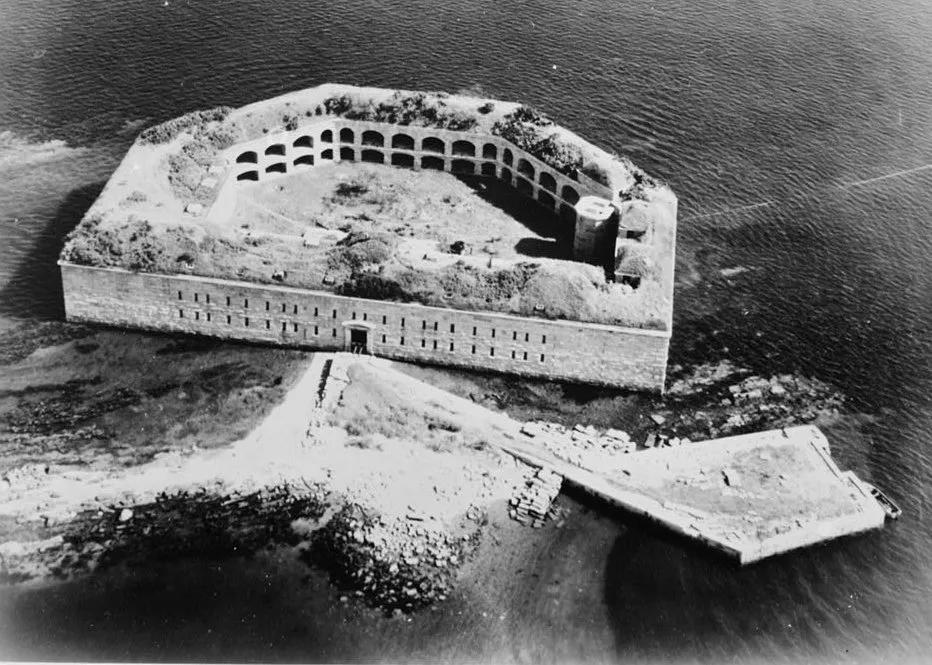
Fort Gorges rises from a ledge in the middle of Casco Bay like something from a dream, a massive granite fortress, six-sided and imposing, accessible only by water. Built during the Civil War to protect Portland harbor, never completed, never armed with its intended weapons, and never fired upon, the fort now stands as one of Maine’s most atmospheric historic sites and one of Portland’s best-kept secrets.
Getting there is half the adventure. No ferry runs to Fort Gorges; visitors must paddle, motor their own boat, or charter transportation. Those who make the effort find a haunting structure where history and decay create an experience unlike anything else on the Maine coast.
The Fort
History
Construction began in 1858 on Hog Island Ledge, part of a coastal defense system designed to protect American harbors from naval attack. The granite fortress was conceived to mount 75 cannons and repel any fleet that threatened Portland.
The timeline:
- 1858: Construction begins
- 1861-1865: Civil War accelerates urgency, but technology changes
- 1865: Construction halted. Rifled artillery has made masonry forts obsolete
- 1876: Completed as a shell, never armed as intended
- World War I: Used for ammunition storage
- 1960s: Transferred to City of Portland
- Present: Maintained by Portland Parks
The irony: By the time Fort Gorges neared completion, advances in artillery. Particularly rifled cannons firing explosive shells, had rendered masonry forts like this one obsolete. The fort that took over a decade to build was outdated before it finished.
The Structure
Fort Gorges is a hexagonal granite fortress rising 60 feet above the water. Its walls are 8-10 feet thick in places, built to withstand cannon fire that would never come.
What you’ll find:
- Multiple levels of casemates (arched chambers designed for guns)
- Open parade ground in the center
- Spiral staircases connecting levels
- Arched passageways and corridors
- Evidence of later military modifications
- Bird colonies (respect nesting areas)
Current Condition
The fort is not restored or maintained as a manicured historic site. It’s raw, weathered, and in varying states of decay. This adds to the atmosphere but requires caution.
Be aware:
- Uneven surfaces throughout
- Some areas are unstable or closed
- No electricity or lighting
- No facilities (no restrooms, no water)
- Bird guano in some areas
Getting There
By Kayak
The most popular approach. Fort Gorges lies about 1.5 miles from East End Beach in Portland.
Launch points:
- East End Beach (closest, public launch)
- Various spots on Portland’s waterfront
The paddle:
- 30-45 minutes each way (depending on conditions)
- Cross open water (not for beginners)
- Check tide and wind before departing
- Paddle early in the day when conditions are typically calmer
Landing: A small dock on the fort’s east side. Can be tricky in waves or at certain tides.
Rental options: Several Portland outfitters rent kayaks and offer guided trips to the fort.
By Private Boat
Those with access to motorboats can reach the fort quickly. The dock accommodates small boats; anchor offshore if the dock is occupied.
By Charter
Some charter services and water taxis offer trips to Fort Gorges. This eliminates paddling but requires scheduling and expense.
What You Cannot Do
- Swim to the fort (too far, too dangerous)
- Take the ferry (no scheduled service exists)
- Walk (it’s an island in the bay)
Visiting the Fort
Landing
The dock is small and can be slippery. Tie up securely. In rough conditions, landing may not be safe, turn back if necessary.
Exploring
Allow 45-90 minutes to explore the fort thoroughly. Bring a flashlight for interior passages.
Highlights:
- The central parade ground
- Upper ramparts with bay views
- Interior casemates and passageways
- Evidence of military history in the architecture
- Views back toward Portland’s skyline
Etiquette
Fort Gorges is a City of Portland park. Please:
- Pack out all trash
- Do not disturb wildlife (birds nest on the walls)
- Stay out of obviously dangerous areas
- Do not deface or remove anything
- Respect other visitors’ experience
Safety
This is an unimproved site. The City of Portland does not guarantee safety.
- Watch your step. Surfaces are uneven and slippery
- Do not climb on unstable structures
- Bring a flashlight for dark passages
- Tell someone your plans before departing
- Check weather and water conditions
- Know your paddling abilities
Practical Information
When to Go
Best conditions:
- Calm days (wind and waves make the crossing dangerous)
- Morning (conditions often calmer, light is good)
- Summer and early fall (warmest, most stable weather)
- Weekdays (fewer visitors)
Avoid:
- Windy days (whitecaps = stay home)
- Foggy conditions (navigation hazards)
- Late afternoon in summer (afternoon storms possible)
What to Bring
- Kayak or boat (obviously)
- Life jacket (required by law)
- Flashlight (essential for exploring interiors)
- Water and snacks
- Sunscreen
- Camera
- Appropriate footwear (not flip-flops)
- Layers (water and stone = cold)
Time Needed
- Paddle out: 30-45 minutes
- Exploration: 45-90 minutes
- Paddle back: 30-45 minutes
- Total: 2-3 hours minimum
Facilities
None. No water, no restrooms, no services. Plan accordingly.
Combining with Portland
Fort Gorges makes an excellent morning adventure paired with an afternoon in Portland:
Sample itinerary:
- 7-8 AM: Launch from East End Beach
- 8-9:30 AM: Explore the fort
- 10-11 AM: Return paddle
- Late morning: Coffee in the East End
- Afternoon: Old Port exploration, lunch
The Experience
You push off from East End Beach, the skyline of Portland receding behind you. The paddle is real. This is open water, not a protected cove. Other islands pass: House Island with its own abandoned fort, various ledges where seals sometimes haul out.
And then Fort Gorges rises ahead, impossibly large, impossibly placed. A granite hexagon growing from rock that barely breaks the surface. You circle it once, looking for the dock, taking it in.
Inside, the fort is a maze of arched passages, spiral stairs, and empty gun platforms. Your flashlight finds graffiti from a century ago, initials carved by soldiers who served here when the fort still mattered. Above, birds wheel and call from nests wedged into the granite.
From the upper ramparts, Portland spreads across the western horizon. Ships move through the harbor. The fort you’re standing on was built to prevent those ships from ever threatening the city, a threat that never materialized, defended against by a fortress never finished.
Fort Gorges exists now in a strange space between history and abandonment, impressive and useless, preserved by its inaccessibility. Those who make the effort to reach it find something rare: a genuine discovery, hidden in plain sight in one of Maine’s busiest bays.
Fort Gorges is Portland’s most dramatic secret, a Civil War fortress rising from Casco Bay, accessible only to those willing to paddle or boat to reach it. The crossing requires planning and respect for conditions, but the reward is an experience available nowhere else: history, atmosphere, and adventure combined in one remarkable structure.