
Pemaquid Point Lighthouse
One of Maine's most photographed lighthouses atop dramatic striped granite ledges. Visiting guide with tide pools and museum.
Pemaquid Point Lighthouse stands on a promontory of metamorphic rock that looks like nothing else on the Maine coast. The ledges flow in parallel bands, gray, white, and rust-striped granite that angles into the Atlantic like frozen waves. Above them rises the 38-foot white tower that has marked this dangerous shore since 1827, warning mariners away from the rocks that have claimed countless ships.
This is not merely a lighthouse; it’s a complete coastal experience. Visitors come for the tower and stay for the geology, the tide pools, the crashing surf, the museum, and the sheer photogenic drama of a place where Maine’s rugged beauty reaches full expression.
The Lighthouse
History
The original lighthouse was constructed in 1827, making Pemaquid Point one of Maine’s earliest light stations. The current tower dates to 1835, rebuilt after the original proved inadequate. John Quincy Adams commissioned the light; it has operated continuously since, automated in 1934.
Key dates:
- 1827: Original lighthouse built
- 1835: Current tower constructed
- 1857: Fourth-order Fresnel lens installed
- 1934: Light automated
- 1997: Listed on National Register of Historic Places
- Current: Active U.S. Coast Guard navigation aid
The Tower
The white-painted brick tower rises 38 feet from a granite foundation embedded in the bedrock, capped by a black lantern room, solid white and black, not striped. Its fourth-order Fresnel lens (still the original from 1857) flashes every six seconds, visible for 14 miles at sea.
Visiting the tower: The tower is open daily for climbing from Memorial Day weekend through Indigenous Peoples’ Day in October, weather permitting. Stairs lead to the lantern room, where the Fresnel lens sparkles in sunlight and the view extends across Muscongus Bay to Monhegan Island and the Camden Hills.
Tower hours: 11 AM to 5 PM daily in season. Later than the park gate opens, so plan the rocks first. Check the current schedule before you go.
Tower fee: $1 minimum donation per visitor, collected by the Friends of Pemaquid Point Lighthouse (cash or check only). The donation supports preservation. Children must be at least 46 inches tall to climb; the rule is a safety requirement and is not waived.
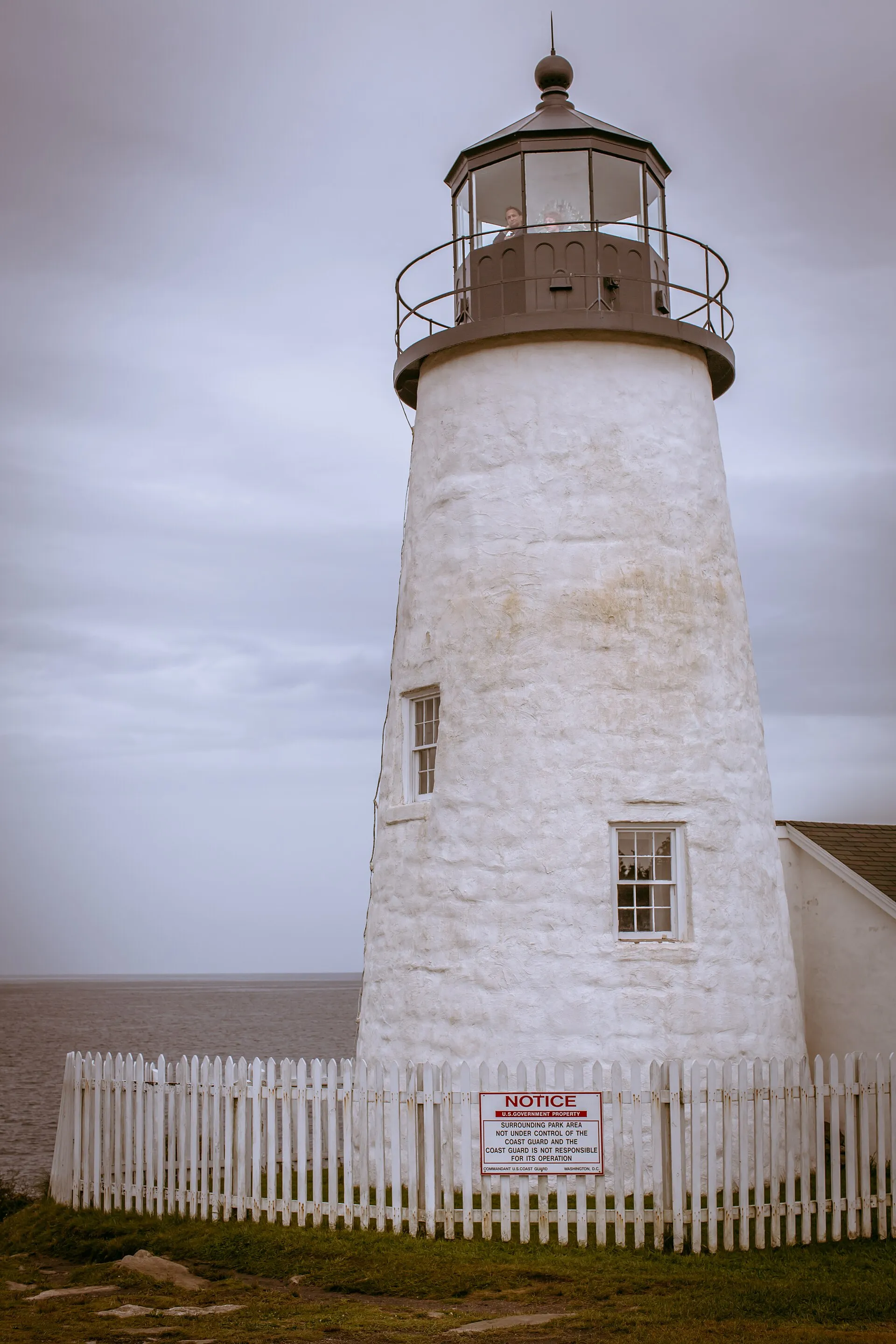 Pemaquid is one of the few Maine lighthouses you can climb, and the visitors visible in the lantern room show why it is worth doing. Photo by WestportWiki via Wikimedia Commons, CC BY-SA 3.0, resized.

The Keeper’s House Museum
The attached keeper’s dwelling houses the Fishermen’s Museum, operated by the town of Bristol. Exhibits cover:
- Local fishing history and traditions
- Lighthouse keeping life
- Maritime artifacts from the region
- The 1857 Fresnel lens (visible up close)
- Historic photographs
Museum hours: Daily 9 AM to 5 PM during the park season. Volunteer-staffed, so hours can be irregular.
Museum fee: Free with park admission.
The Rocks
Geological Wonder
The real star of Pemaquid Point may be the rock formations. These are not typical Maine granite. They’re metamorphic, transformed by heat and pressure millions of years ago into the distinctive banded pattern visible today.
The ledges slope into the sea at dramatic angles, their parallel stripes looking almost artificial in their regularity. The rock is smooth in some places, rough in others, carved by millennia of waves.
Geological term: The formations are technically gneiss and schist, heavily folded and metamorphosed. For visitors, they’re simply spectacular.
Tide Pools
Where the rock meets the water, tide pools form in natural depressions. At low tide, these pools reveal marine life:
- Sea stars (starfish)
- Sea urchins
- Crabs
- Anemones
- Periwinkles and other snails
- Seaweed varieties
- Mussels and barnacles
Best viewing: Low tide. Check tide charts before your visit.
Tide pool etiquette:
- Look, don’t remove
- Replace any rocks you move
- Watch your step. Creatures live beneath
- Keep an eye on the incoming tide
Surf and Spray
When waves roll in, Pemaquid Point transforms. Water surges into channels, spray launches skyward, and the thunder of surf against rock fills the air. Storm watching is popular, but dangerous.
Safety note: Visitors have been swept from these rocks by unexpected waves. Stay back from the water’s edge, especially in rough conditions. The granite is slippery when wet.
Visiting Pemaquid Point
Location
Pemaquid Point is located at the tip of the Pemaquid Peninsula, about 15 miles south of Route 1 in the Bristol/Damariscotta area.
Address: 3115 Bristol Road, Bristol, ME 04539
From Route 1: Take Route 130 south from Damariscotta. Follow signs to Pemaquid Point (about 14 miles).
Pemaquid Point Lighthouse Park
The lighthouse and grounds are managed as a park by the Town of Bristol.
Park hours: 9 AM to 5 PM daily, from mid-May through mid-to-late October (the closing date varies year to year). Outside that season the tower, museum, and gift shop are closed and no fee is collected.
Entry fee: $4 for adults and children 12 and up, $1 for children 5-11, free for children 4 and under. The fee is charged per person, not per vehicle. Tickets are good for the full day, so you can leave and come back. Bristol residents with a Parks & Recreation pass enter free.
Parking: Lot adjacent to the lighthouse. Can fill on peak summer days. Arrive close to the 9 AM opening for easiest parking.
Confirm before you go: Fees and the closing date change year to year. The Town of Bristol’s park page has current admission and hours; the Friends of Pemaquid Point Lighthouse publish the tower climbing schedule.
Facilities
- Restrooms near parking lot
- Picnic tables on the grounds
- Gift shop (seasonal)
- No food service on-site
Accessibility
The main viewing areas near the lighthouse are accessible. The rock ledges are natural terrain, uneven, sloped, and challenging for those with mobility limitations.
When to Visit
Best Times
For photography:
- Sunrise: The eastern exposure catches morning light beautifully
- Sunset: Creates dramatic silhouettes and warm tones on the tower
- Storm conditions: Dramatic but dangerous; maintain safe distance
For tide pools:
- Low tide (check tide charts)
- Morning hours often calmer
For fewer crowds:
- Early morning (before 9 AM)
- Weekdays
- Shoulder season (May, September, October)
Seasonal Considerations
Summer: Peak crowds, all facilities open, best weather for tide pooling. Parking lot fills early on sunny weekends.
Fall: Fewer visitors, spectacular light. Tower and museum may have reduced hours.
Spring: Variable weather, minimal crowds. Some facilities may not yet be open.
Winter: Park accessible for day use but lighthouse and museum closed. Dramatic storm watching (from safe distance).
Photography Tips
Pemaquid Point is one of Maine’s most photographed locations. The combination of lighthouse, rocks, and sea creates endless compositions.
Classic Shots
Lighthouse and rocks: Wide angle from the ledges below, capturing both tower and striped granite.
Fresnel lens detail: Close-ups of the lens inside the tower.
Tide pool macro: Small world photography in the pools.
Surf action: Long exposures smooth the water; fast shutter speeds freeze spray.
Sunrise silhouette: Tower against the dawn sky.
Technical Tips
- Bring a polarizer to cut glare on water and wet rock
- Wide-angle lens for landscape compositions
- Macro lens for tide pool details
- Tripod for sunrise/sunset and long exposures
- Lens cloth. Spray is real
Composition Advice
- Use the rock striations as leading lines toward the lighthouse
- Include people for scale
- Low angles emphasize the drama of the rocks
- Return in different conditions, same location, infinite variations
Nearby Attractions
Colonial Pemaquid State Historic Site
About 3 miles from the lighthouse, this archaeological site preserves the remains of a 17th-century English settlement. Museum, replica buildings, and walking paths. Separate admission.
Fort William Henry
Adjacent to Colonial Pemaquid, a reconstruction of the 1692 fort. The tower offers views across the harbor.
Pemaquid Beach Park
A rare sandy beach on this rocky coast. Swimming, picnicking, and more gentle shoreline exploration. About 2 miles from the lighthouse.
Rachel Carson Salt Pond Preserve
Near New Harbor, this quarter-acre tidal pool was made famous by marine biologist Rachel Carson, who studied here. Excellent tide pooling in a quieter setting.
Practical Tips
What to Bring
- Camera (you will take pictures)
- Comfortable walking shoes with good grip (rock surfaces can be slippery)
- Layers (ocean air is cooler than inland)
- Sunscreen and sunglasses
- Binoculars (for birds, boats, and distant islands)
- Cash for admission and gift shop
What to Avoid
- Flip-flops or smooth-soled shoes (dangerous on wet rock)
- Getting too close to the surf line
- Disturbing tide pool creatures
- Rushing, this place rewards lingering
Dining
No food service at the lighthouse. Nearby options include:
Shaw’s Fish & Lobster Wharf (New Harbor): Casual waterfront dining, fresh seafood, local favorite.
The Contented Sole (New Harbor): Seafood and lobster.
Damariscotta: 14 miles north, with multiple restaurant options.
Lodging
The keeper’s quarters at Pemaquid Point are not available for overnight stays. Nearby accommodations include:
- Inns and B&Bs in the Pemaquid/New Harbor area
- Hotels in Damariscotta
- Vacation rentals on the peninsula
The Pemaquid Experience
You walk from the parking lot toward the tower and the Atlantic opens before you. The lighthouse rises white against the blue. But your eye goes to the rocks, those extraordinary striped ledges angling toward the surf like the pages of a stone book.
You pick your way down onto the granite. The surface is unexpectedly smooth in places, rough in others. The bands of color flow beneath your feet, across the point, into the water. Waves surge into the channels, retreat, surge again. The rhythm is hypnotic.
In a tide pool, a sea star clings to rock that was ancient before life crawled from the sea. The lighthouse keeper’s signal has flashed from this point for nearly 200 years, yet the rocks remember when there was no keeper, no lighthouse, no humans, just the patient conversation of water and stone.
That conversation continues. The surf speaks; the rocks listen. The light flashes. And visitors stand on this improbable geology, cameras in hand, trying to capture something that photographs never quite convey: the feeling of a place where Maine’s coast reaches one of its finest expressions.
Pemaquid Point is worth the drive down the peninsula. The lighthouse alone would justify the trip; combined with the remarkable rock formations and the ever-changing play of surf and light, it becomes one of the essential experiences on the Maine coast.