
Portland Head Light: Parking, Hours & Fort Williams
Visit Portland Head Light in Fort Williams Park: parking fees, park hours, museum access, cliff walks, and practical tips for planning your visit.
Updated
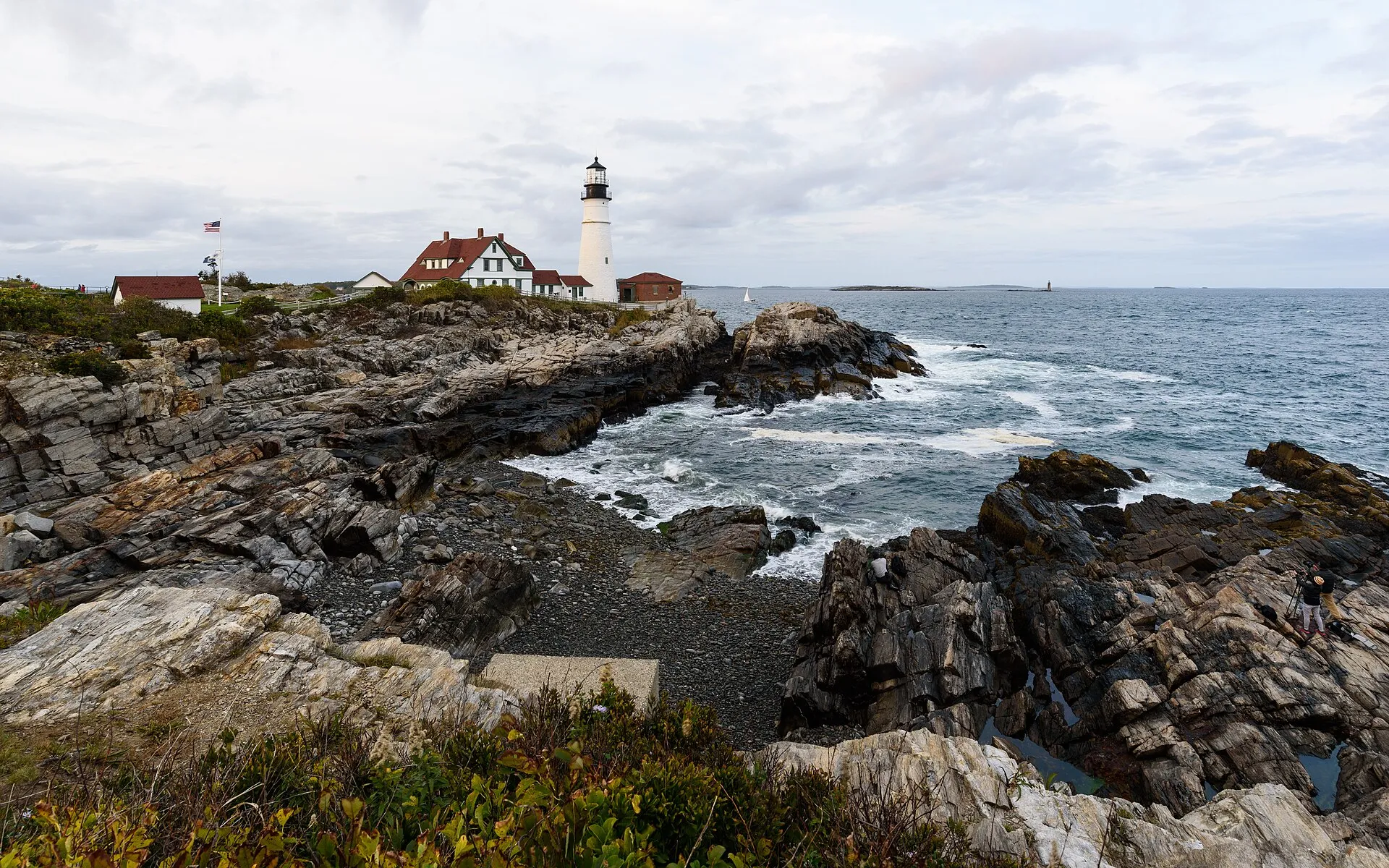
Portland Head Light is one of the most photographed lighthouses in the country, and it has earned the attention. Its construction was authorized by President Washington, it was first lit on January 10, 1791, and it has marked the approach to Portland Harbor ever since. It represents both the birth of American maritime infrastructure and the enduring appeal of Maine’s rugged coast.
But the lighthouse is just the centerpiece of Fort Williams Park, a spectacular 90-acre green space that offers far more than a single photo opportunity. Plan for at least two hours. You’ll want them.
Plan Your Visit
For a first visit, start with parking, hours, and access, then decide whether to include the museum, the cliff walk, or a food stop. The practical details below distinguish visiting the park from entering the museum or lighthouse; they are not the same experience.
The History Behind the Light
Portland Head had been a lookout long before it was a light station. In 1776, the new Town of Cape Elizabeth posted a guard of eight soldiers there to warn residents of British attack. Construction of the lighthouse began in 1787, when the General Court of Massachusetts provided $750. In 1790, when the federal government took over responsibility for all lighthouses, Congress appropriated $1,500 for its completion.
The original tower measured 72 feet from base to lantern deck and was lit with 16 whale oil lamps, primitive by modern standards, but a real advance for sailors navigating these waters in the dark. It was first lit on January 10, 1791. A fourth-order Fresnel lens and a cast iron staircase went in by 1864, and a second-order lens the year after; part of that lens is in the museum today.
Keepers and their families lived on the point for nearly two centuries. The current Keepers’ Quarters went up in 1891 as a two-story duplex for the head keeper and the assistant keeper, and it stayed their home until 1989. Late on Christmas Eve in 1886, the three-masted bark Annie C. Maguire struck the ledge below; keeper Joshua Strout, his family and volunteers rigged a ladder as a gangplank and got every one of the crew ashore. On August 7, 1989, Petty Officer Davis Simpson struck the flag for the last time at the ceremony marking the light’s automation.
The Coast Guard still maintains the light and the fog signal. Its 2025 Light List gives Portland Head Light a white flash every four seconds and a nominal range of 19 nautical miles. Everything else, the grounds and the Keepers’ Quarters included, was leased to the Town of Cape Elizabeth in 1990 and deeded to the town three years later, and the town manages it today. The station was listed on the National Register of Historic Places in 1973.
The Highlights
1. The Lighthouse and Museum
The tower is shut to the public almost all year. It opens only for Open Lighthouse Day, and the two official sites do not agree on whether that is one day a year or two, so do not build a trip around climbing it. The Museum at Portland Head Light, in the former Keepers’ Quarters, is the part you can go inside: Fresnel lenses, keepers’ artifacts, models and a timeline that runs from the origin of the light to its automation in 1989.
- Season: Memorial Day to Indigenous Peoples’ Day.
- Hours: 10:00 am to 4:00 pm, seven days a week. The gift shop keeps the same hours.
- Admission: $2 adults, $1 children 6 to 18, free under 6.
2. The Cliff Walk
The one-mile Cliff Walk Trail runs along the edge of the headland and gives the classic view that has appeared in countless photographs, films, and postcards. This is where you get that shot, the white tower framed by rugged rock and surf, especially dramatic during storms or at sunset.
- Free guided walk: From mid-May to mid-October, park staff lead a free 40-minute walk along the Cliff Walk at 3 PM daily, weather permitting, covering the fort structures, native plants, shipwrecks and lighthouses. Gather at the Visitor Services Station in Central Parking. It is capped at 30 people, first come first served, and the town does not recommend it for anyone with mobility issues.
- Safety: The rock is slick when wet and the surf runs higher than it looks from above. Keep well back from the water line, and keep children close.
3. Goddard Mansion Ruins
Up the hill from the lighthouse stand the stone ruins of Goddard Mansion, built in 1858-59 for the local businessman John Goddard and designed by the New York architect Charles A. Alexander. It predates the fort. The Army acquired it in 1900 and used it as non-commissioned officers’ quarters, later adding an NCO club. It was badly deteriorated by the time the town took the property over, the interior debris was burned in a controlled fire in the 1980s, and the walls were fenced off in 2009. Only the outer walls remain, open to the sky, and they look like something from a Gothic novel transplanted to Maine.
4. Battery Keyes and Military Ruins
Fort Williams was an active military installation through both World Wars, and remnants of that era dot the park. The Army bought its first 14 acres at Portland Head in 1872 to establish a sub-post of Fort Preble, completed its first three batteries, Sullivan, DeHart and Hobart, in 1898, and named the post Fort Williams in 1899 after Brevet Major General Seth Williams. Battery Blair, the big 12-inch disappearing-carriage battery, followed in 1903, and Battery Keyes, a small two-gun rapid-fire battery near Ship Cove, in 1906. Battery Keyes was the only pre-war battery still in service through World War II, and it sits empty today. The fort closed in the early 1960s, and Cape Elizabeth bought the 90-acre property on December 1, 1964 for $200,000.
5. The Parade Ground
The massive grassy expanse in the center of the park is arguably the best kite-flying spot in Maine. On windy days (most days, honestly), you’ll see elaborate stunt kites and simple diamond shapes filling the sky. It’s also perfect for picnics, frisbee, and simply lying on your back watching clouds.
6. Ship Cove Beach
Ship Cove is the small rocky beach on the north side of the entrance road, with its own parking lot, a swing set, picnic tables and benches. A patch of sand appears at low tide, and the view out is to Ram Island Ledge Light. The water is very cold. On the south side of the cove, built into the granite cliff, sits the underground Mining Casemate, where officers once fired the electrically controlled mines strung across the channel.
Food: Bite Into Maine
Fort Williams is where Bite Into Maine started. They opened their original food cart in the park in 2011 and still run a truck here, window service only, seasonally from April to early November.
- The Options: Their lobster rolls come in six styles: Maine (mayo and chives), Connecticut (just warm butter on top), Picnic (coleslaw, butter and celery salt), Chipotle (smoky chipotle mayo), Curry (yellow Indian curry mayo) and Wasabi (zingy wasabi mayo). A flight of three mini rolls lets you mix and match.
- The Experience: Eating a lobster roll on a picnic table overlooking the lighthouse, with waves crashing on the rocks below, is peak Maine.
- The Reality: Lines can be long during peak season, they cannot take preorders at this location, and they may close for weather. Check their hours page before you count on it.
Photography Tips
Portland Head Light attracts photographers from around the world, and for good reason. Here’s how to get your best shots:
- Golden Hour: Sunrise and sunset light transforms the lighthouse. Morning light illuminates the east-facing cliffs; evening light paints the tower in warm tones.
- Storm Watching: Some of the most dramatic images come during nor’easters, when waves crash against the rocks and spray fills the air. Just be extremely careful, and use a weather-sealed camera.
- Different Perspectives: Everyone gets the obvious shot from the cliff walk. Try Ship Cove, where the beach and Ram Island Ledge Light give you a different frame, or the path behind the lighthouse for less-photographed angles.
- Seasonal Variations: Each season offers something different, autumn foliage, winter snow on the rocks, spring wildflowers, summer crowds that can themselves become interesting subjects.
Logistics
- Location: 1000 Shore Road, Cape Elizabeth, Maine 04107. The park phone, 207-799-2661, is answered mid-May through mid-October.
- Hours: Open year-round, sunrise to sunset.
- Park entry: Free. Donations are appreciated, but nobody charges you to walk in.
- Parking: Pay and display at four lots, the Picnic Shelter, the Parade Ground, Ship Cove and Central Parking. $6 buys a two-hour minimum, then it is $2 per hour, and an annual season pass is $25. The meters take credit or debit cards only, no cash. There is no charge to park in the Overflow lot.
- Museum: Memorial Day to Indigenous Peoples’ Day, 10:00 am to 4:00 pm daily. $2 adults, $1 children 6 to 18, free under 6.
- Pets: Dogs are allowed in the park but must be on a leash except in the off-leash area.
- Practicalities: There are no trash bins, so carry out whatever you carry in. Tobacco, alcohol and other drugs are prohibited on park grounds, and commercial photography needs prior permission from the town.
- Accessibility: The ground around the lighthouse viewing area is the easiest going. The cliffs, the ruins and the beach all involve uneven terrain, and the town does not recommend its guided Cliff Walk for anyone with mobility issues.
Making the Most of Your Visit
Quick Visit (30-60 minutes): Walk to the lighthouse, take photos from the cliff walk, grab a lobster roll if the line isn’t too long.
Half Day (2-3 hours): Add the museum, explore Goddard Mansion and Battery Keyes, let kids run on the parade ground, find Ship Cove beach.
Full Experience: Come for sunrise or sunset photography, pack a picnic, fly a kite, explore every corner of the 90 acres, and understand why this place has captivated visitors since George Washington ordered it built.
Nearby Attractions
- Two Lights State Park: Rocky headland in Cape Elizabeth, less crowded, excellent for storm watching. Do not go expecting a lighthouse visit: the twin lights sit outside the park at the end of Two Lights Road and neither is open to the public.
- Kettle Cove: Small beach nearby, good for quick swimming.
- Crescent Beach State Park: Longer sandy beach south along the coast.
- Portland: The city is just 15 minutes away, combine your visit with Portland’s Old Port, restaurants, or breweries.
Whether you spend 20 minutes taking a selfie or half a day exploring the ruins, eating lobster, and contemplating the generations of keepers who tended this light, Fort Williams delivers exactly what visitors to Maine hope to find: history, natural beauty, and that ineffable coastal atmosphere that makes this place unlike anywhere else.
Seasonal Highlights
Each season offers something different at Fort Williams:
Spring: Wildflowers bloom across the grounds, and the park is blissfully uncrowded. Weather can be unpredictable, but you might have the cliff walk nearly to yourself.
Summer: Peak season brings crowds, food trucks, and long days. Early morning and evening visits avoid the worst congestion and offer the best light.
Fall: Foliage frames the lighthouse, temperatures cool, and crowds thin after Labor Day. Many consider this the ideal time to visit.
Winter: The park remains open, and storm watching can be spectacular. Dress warmly. The wind off the ocean is bitter. Few tourists, many dramatic photo opportunities.
Why Portland Head Endures
In an era of instant images and virtual experiences, places like Portland Head Light matter more than ever. This isn’t a reconstruction or a themed attraction. It’s an authentic piece of American history that has served its purpose continuously since George Washington’s administration.
The lighthouse has witnessed the entire history of the American republic unfold. Ships passed this beacon carrying troops to every war, immigrants seeking new lives, and goods that built the nation’s economy. The keepers who tended the light lived through epidemics, depressions, and world wars, climbing the tower each evening to ensure the flame burned true.
When you stand at Portland Head today, you’re standing where countless others have stood, mariners taking their bearings, keepers watching for ships in distress, artists capturing the scene, and families making memories. That continuity connects you to something larger than any single visit. It is why the Friends of Fort Williams Park count somewhere between 800,000 and a million visitors a year, and why the lighthouse remains, after more than two centuries, Maine’s most iconic image.