
Sand Beach: Acadia's Arctic Paradise
Nestled between mountains and ocean, this gorgeous beach offers some of the best views, and coldest water, in Maine.
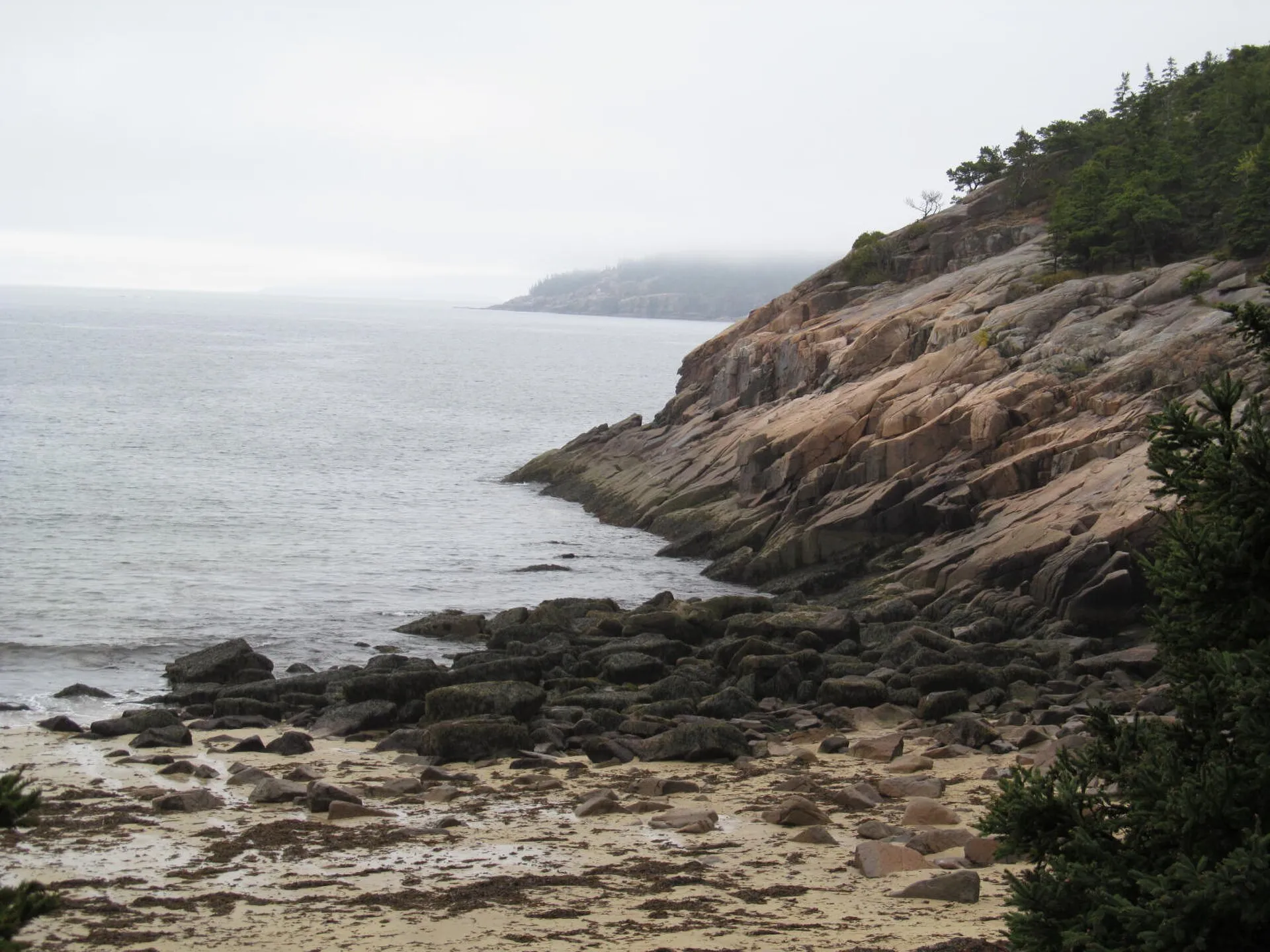
In a national park defined by pink granite cliffs and rocky shorelines, Sand Beach is a geological surprise. This 290-yard crescent of sand, tucked into a protected cove between the mountains and the sea, is Acadia’s only true sand beach, and one of the most photographed spots in Maine.
The setting is spectacular. The Beehive mountain rises directly behind the beach, its distinctive profile dominating the view inland. Great Head peninsula wraps around to the east, sheltering the cove. And the sand itself is remarkable, not ordinary quartz, but a blend of shell fragments that sparkle in the sunlight.
What Sand Beach is not: a swimming beach for the casual visitor. NPS gives the water as 50-60°F, cold enough to take your breath away even in August. But for those willing to brave the chill, or content to admire from the sand. Sand Beach offers a Maine coast experience like no other.
The Sand: A Geological Wonder
Composition
Look closely at the sand at your feet. Unlike most beaches, which are primarily quartz, Sand Beach sand is roughly 70% shell fragments, crushed mussels, sea urchins, periwinkles, and other mollusks pounded into fine grains by millennia of wave action.
What this means: The sand has a unique texture and appearance, with tiny shell fragments visible among the grains. In certain light, it sparkles with fragments of shell material.
How It Got Here
Sand Beach exists because of the perfect convergence of geography: the sheltered cove, the rocky headlands that trap sediment, and the endless supply of shells from the marine life in the surrounding waters. Most of Maine’s coast is too exposed for sand to accumulate, the waves simply wash it away. Here, the cove’s protection allows the beach to persist.
The Color
The high shell content gives the sand a slightly different color than typical beaches, sometimes appearing almost pink or cream-colored depending on the light. The effect is subtle but noticeable.
The Water: The Polar Plunge
Temperature
Sand Beach is beautiful, but it is emphatically not warm. NPS gives the water temperature as 50-60°F (10-16°C) even at the peak of summer, and there are no lifeguards. The cold Labrador Current flows down from the north, and the deep, sheltered cove doesn’t warm significantly even in August heat.
For context: 55°F water can cause cold shock response. Most people last only minutes before their bodies demand escape.
The Experience
Swimming at Sand Beach is less “swimming” and more “controlled panic followed by numbness.” Here’s what to expect:
- The run in: You’ll wade into shin-deep water and immediately understand. By knee-deep, your legs are tingling.
- The plunge: Most people dive under once to get it over with. The cold hits your chest like a punch.
- The screaming: This is involuntary and universal. You’ll hear it from others. You’ll contribute.
- The exit: After 30 seconds to 2 minutes, your body will strongly suggest leaving. Listen to it.
- The aftermath: Once out, you’ll feel incredibly alive. The endorphin rush is real.
Is It Worth It?
For many visitors, the Sand Beach polar plunge is a bucket-list item, a way to say you actually swam in Maine, not just looked at it. The lifeguards are used to watching tourists run in and immediately run out. There’s no shame in the quick dip.
Safety
Lifeguards: On duty during summer season (typically late June through Labor Day).
Actual swimming: Strong swimmers can manage longer immersion, but be aware of your limits. Hypothermia is a real risk with extended exposure.
Medical conditions: If you have heart conditions or other health concerns, the cold shock may be dangerous. Consult your doctor.
Best approach: Wade in gradually if the shock of diving seems too intense. And always swim with others nearby.
The Setting
The Beehive
Rising directly behind the beach, the Beehive is one of Acadia’s most iconic peaks. Its distinctive rounded profile is impossible to miss from the sand.
The view from below: From Sand Beach, you can watch hikers ascending the iron rungs bolted into the cliff face. They look tiny against the granite.
The view from above: From the Beehive summit, Sand Beach appears as a perfect crescent of white sand far below.
Great Head Peninsula
To the east, the rocky Great Head peninsula wraps around to shelter the beach. The Great Head Trail traverses this headland, offering spectacular views back toward Sand Beach and the Beehive.
The Cove
The sheltered nature of the cove creates a microenvironment. Waves are generally gentler here than on exposed coastline. The water is calmer, the beach more protected from wind.
Hiking from Sand Beach
Sand Beach serves as the trailhead for three of Acadia’s best coastal experiences:
The Beehive Trail
Distance: 1.6 miles round trip Difficulty: Strenuous (exposed climbing on iron rungs) Time: 1-2 hours
The Beehive is Acadia’s most famous “iron rung” trail, a route that ascends the cliff face using metal handholds and footholds bolted into the granite.
What to expect:
- Near-vertical sections on iron rungs
- Narrow ledges with significant exposure
- Drop-offs of 100+ feet
- Incredible views from the summit
Who should avoid it:
- Anyone afraid of heights
- Children (though some families with older kids do it)
- Anyone after rain when rocks are slippery
- People uncomfortable with exposure
Alternative: The Bowl Trail loops around the back of the Beehive without the exposure, reaching the same area via a longer, easier route.
Great Head Trail
Distance: 1.7-mile loop Difficulty: Moderate Time: 1-1.5 hours
This trail loops around the Great Head peninsula, the rocky headland protecting Sand Beach’s eastern flank.
Highlights:
- Spectacular views back toward Sand Beach and the Beehive
- Ruins of an old stone teahouse
- Rocky coastline and ocean views
- Less crowded than the Beehive
Best direction: Counterclockwise, starting from the eastern end of Sand Beach.
Ocean Path
Distance: 2.2 miles one way, 4.4 miles round trip (Sand Beach to Otter Point) Difficulty: Easy for the first 0.7 miles to Thunder Hole, then uneven Time: 1-2 hours each way
Ocean Path is Acadia’s most popular walk, following the coastline from Sand Beach south past Otter Cliff to Otter Point. The first stretch to Thunder Hole is level and gravel. Past Thunder Hole the footing gets uneven and granite staircases carry the trail past Otter Cliffs.
What you’ll pass:
- Thunder Hole (see below)
- Monument Cove
- Otter Cliff
- Countless ocean views and rocky outcrops
Accessibility: Level and gravel-surfaced as far as Thunder Hole. Beyond that there are granite staircases and uneven rock, so the southern half is not accessible.
Return: Walk back, or use the Island Explorer bus from Otter Cliff.
Thunder Hole
Just south of Sand Beach along Ocean Path (about 0.5 miles), Thunder Hole is a narrow inlet in the granite where waves compress and explode upward with a thunderous boom.
When It Works
Thunder Hole needs the right conditions to perform:
- Rising tide (NPS says one to two hours before high tide)
- Significant wave action (calm days produce little effect)
- Right angle swell (waves need to hit the inlet correctly)
When conditions align, waves funnel into the narrow chasm, compress, and blast upward with a sound like a cannon shot, sending spray 40+ feet into the air.
When It Doesn’t
On calm days or at the wrong tide, Thunder Hole is just a quiet crevice in the rocks. Many visitors arrive expecting drama and find nothing. Check conditions before making it a priority.
Safety
People have been swept off the rocks at Thunder Hole by unexpected waves. Stay behind the railings. Don’t climb down for a closer look. The granite is slippery, and the waves are unpredictable.
Practical Information
Getting There
Sand Beach is on the Park Loop Road, about 3 miles from the Hulls Cove Visitor Center entrance.
By car: Follow the one-way Park Loop Road. The Sand Beach parking lot is on the right, well-signed.
By bus: The Island Explorer (free, seasonal shuttle) stops directly at Sand Beach. Highly recommended, avoids parking hassles.
Parking
The problem: Sand Beach has one of the smallest parking lots for one of Acadia’s most popular destinations. On summer days, the lot fills by 9-10 AM and stays full until evening.
Strategies:
- Arrive before 9 AM
- Come late afternoon (after 4 PM) when people leave
- Take the Island Explorer bus (recommended)
- Visit on cloudy or cooler days when crowds thin
- Come in shoulder season (May, September-October)
Entrance Fee
Sand Beach is within Acadia National Park. You’ll need a park entrance pass.
Current fees (2026):
- 7-day vehicle pass: $35
- 7-day pass on foot or bicycle: $20 per person
- Annual Acadia pass: $70
- Annual America the Beautiful pass: covers all national parks
If you are not a US resident, read this before you budget. The park now charges an additional $100 per person, for everyone aged 16 and over, on top of the standard entrance fee. It is waived only if you enter on an Annual or America the Beautiful pass. For a family of four visiting from abroad that is $35 for the car plus $400 in surcharges, so buying an annual pass instead is dramatically cheaper. Check the current fee page before you travel.
Driving Cadillac Summit Road needs a separate $6 vehicle reservation, required 20 May to 25 October and booked through recreation.gov. It is not needed anywhere else in the park, and not needed at all if you arrive on foot, by bike, or by taxi.
Dogs are not allowed on Sand Beach from 15 June to 8 September. Outside those dates they are welcome on a leash no longer than six feet.
Facilities
At Sand Beach:
- Restrooms and changing rooms in the parking area
- Stairs leading down to the beach
- Lifeguard station (seasonal)
- No food service
Note: The stairs to the beach mean it’s not wheelchair accessible, though the Ocean Path above offers accessible coastal views.
What to Bring
- Towel (for post-polar-plunge)
- Layers (even summer days can be cool with ocean breeze)
- Water and snacks (no concessions)
- Sunscreen (reflection off sand intensifies sun)
- Hiking shoes if planning to do trails
- Camera (the views demand it)
Best Times to Visit
Time of Day
Early morning (before 9 AM): Easiest parking, quieter beach, soft light for photos.
Midday: Most crowded, hardest parking, but warmest (relatively).
Late afternoon (after 4 PM): Crowds thin, golden light, parking opens up.
Season
Summer (June-August): Peak season. Warmest water (still cold), lifeguards on duty, most crowded. Parking is extremely difficult.
Fall (September-October): Excellent choice. Fewer crowds, beautiful foliage backdrop, comfortable hiking weather. Water is cold; no lifeguards.
Spring (April-May): Quiet and uncrowded. Can be cold and foggy. Great for photography and solitude.
Winter: The beach is accessible year-round, though Park Loop Road may be partially closed. Dramatic and empty, but very cold.
Combining Sand Beach with Other Activities
A Classic Acadia Morning
- Arrive at Sand Beach by 8 AM
- Quick beach walk and photos (and optional polar plunge)
- Hike the Beehive (1-2 hours)
- Walk Ocean Path to Thunder Hole (check tide timing)
- Continue to Otter Point or return via bus
- Lunch in Bar Harbor
For Families
- Beach time at Sand Beach (sand castle building, wading)
- Walk Ocean Path (level and stroller-friendly as far as Thunder Hole)
- Skip the Beehive (not kid-appropriate)
- Great Head Trail is doable for older kids
Sand Beach is Acadia’s postcard, the image that appears on countless guidebooks, calendars, and Instagram feeds. But it’s more than a photo opportunity. The unique shell-sand beach, the frigid water that few dare enter, the trails climbing to spectacular viewpoints, the thunder of waves at nearby Thunder Hole, together they create one of the essential Maine coast experiences. Just don’t expect warm water.