
Where to See Moose in Maine: Moosehead, Baxter & More
Compare Maine moose-watching areas, from Moosehead Lake to Baxter and the Golden Road. Find seasonal timing, access information, and safe viewing advice.
Updated
Moose are the largest member of the deer family. Maine’s Department of Inland Fisheries and Wildlife puts them at up to seven feet tall, with an average prime-age bull weighing 1,106 pounds and an average cow 836 pounds. The largest bull ever taken in Maine dressed out at 1,330 pounds, meaning it weighed roughly 1,767 pounds alive. When you encounter one for the first time, watching it wade chest-deep into a pond to feed on aquatic plants, water streaming from its antlers, utterly indifferent to your presence, you realize the word “wildlife” doesn’t quite cover it.
Maine is home to the highest moose population in the lower 48 states, according to IFW, which credits abundant habitat, no effective predators, and wildlife management. IFW does not publish a current statewide headcount. Its last published estimate is around 76,000 in 2012, and it says the core population has remained stable over the last ten years while winter tick has cut reproduction and calf survival. Moose are not rare here. They are, however, elusive, and seeing one takes knowing where to look and having patience.
Choose Your Moose-Watching Trip
Looking for a place to start? Jump to Moosehead Lake, Baxter State Park, or the Golden Road near Millinocket. Compare seasonal patterns and read the viewing safety advice before planning a roadside stop or booking a guide. These are places to look, not promises of a sighting.
Understanding Moose Biology and Behavior
Moose behave nothing like the white-tailed deer most people know. Here is what IFW says drives their behavior.
Why Water?
Moose are herbivores that live on browse, the leaves and twigs of woody plants: willow, aspen, birch, maple, pin cherry, mountain ash, and balsam fir through the winter. Water matters because of what grows in it. IFW notes that aquatic plants such as pondweed and water lily carry more sodium than woody vegetation and are an important part of the diet. Natural salt licks are rare in Maine, so moose also work road shoulders for salt runoff as an artificial lick.
Forest cover matters too. IFW describes moose using shade for bedding and ruminating through the summer, which is why midday searches in open country tend to disappoint. You will also see a precise temperature threshold quoted for moose heat stress. IFW does not publish one, so we do not repeat it.
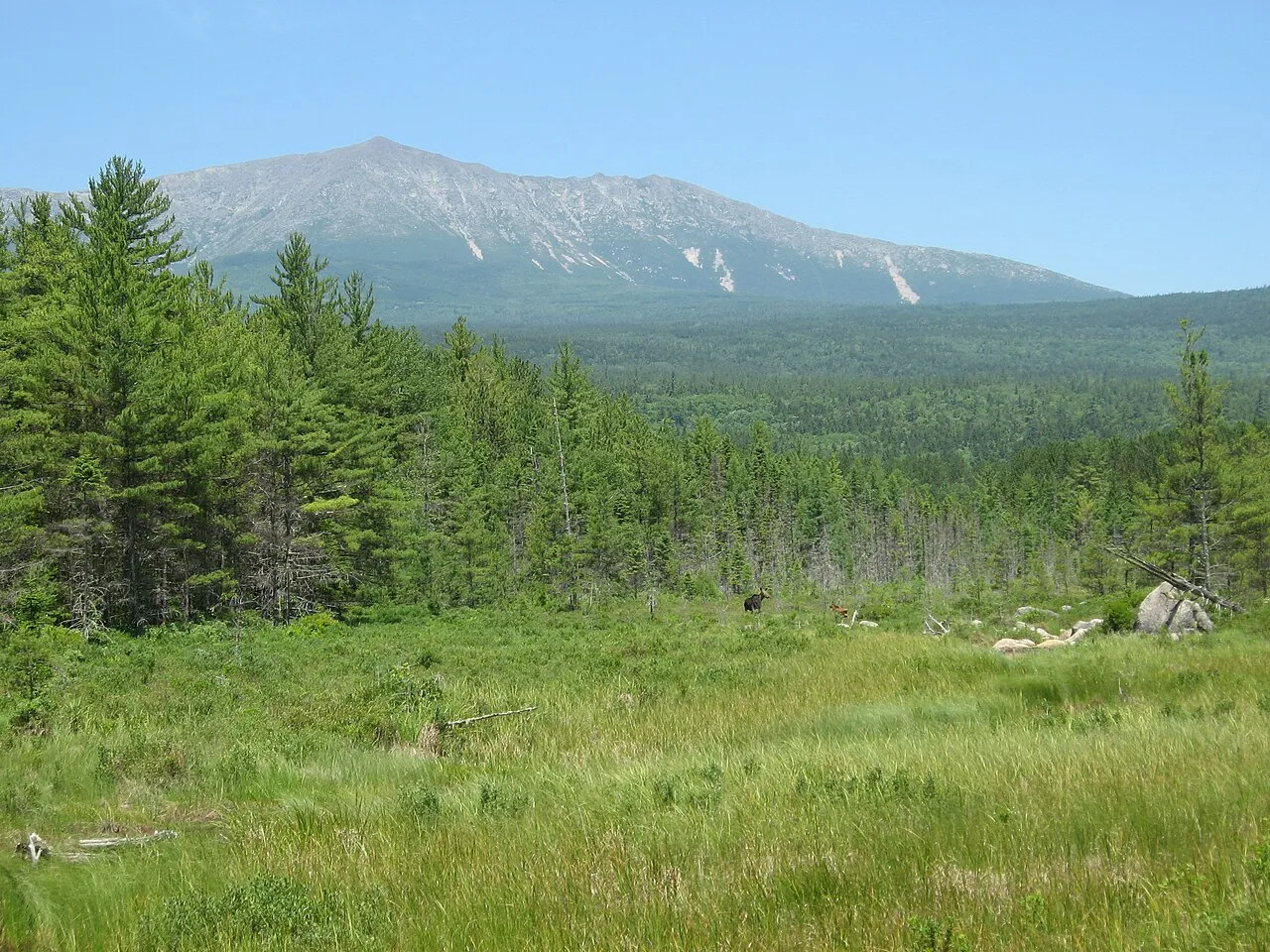 Worth setting expectations with: this is what a moose sighting usually looks like, a dark shape out across a bog rather than an animal beside the road. Katahdin behind. Photo by Fredlyfish4 via Wikimedia Commons, CC BY-SA 4.0, resized.

The Crepuscular Rhythm
IFW’s answer to the question of when moose are active is short: “Active mostly at dusk and dawn.” That is the honest version. There is no published clock window, and any guide that gives you one to the hour is guessing. Plan around first and last light, expect less at midday, and accept that moose do not read schedules.
Seasonal Patterns
Spring: Roadside salt runoff is a genuine draw, since IFW says natural licks are scarce in Maine. Cows give birth each May, usually to one calf and sometimes two.
Summer: Biting insects are at their worst and moose spend the warm hours in shade or water. Dawn and dusk remain the active windows.
Fall: IFW says the rut begins in late September and lasts into early October. Bulls range more widely looking for cows and turn up in places they otherwise would not. That is a narrower window than the “September through October” quoted almost everywhere else.
Winter: Bulls shed their antlers in early winter to conserve energy, and moose lean on balsam fir when the hardwoods have dropped their leaves. Logging roads and snowmobile trails open up viewing, but they also demand real winter travel skills.
Prime Moose Territory: Where to Look
Route 16 (Rangeley to Stratton): Moose Alley
The stretch of Route 16 between Rangeley and Stratton is often called “Moose Alley,” though the nickname is unofficial and gets applied to other roads too, including Route 201 north of Skowhegan. What makes this run worth driving is the habitat rather than the name: mixed forest broken up by wetlands, ponds, and regenerating cuts, which is the combination IFW describes as core moose country. Road salt runoff gives moose a reason to work the shoulders.
Strategy:
- Drive slowly around first and last light
- Focus on wet areas: marshes, beaver ponds, stream crossings
- Scan roadsides for movement and shapes that don’t fit (moose are dark and large)
- Watch the regenerating cuts, since IFW ties moose abundance to the young trees and shrubs that follow commercial harvesting
Timing: Late spring through early autumn covers the most active stretch, and IFW’s rut window of late September into early October pushes bulls into the open. Nobody publishes sighting rates for a given road, so treat any percentage you see as invented.
Caution: Moose are dark and stand tall enough that headlights catch the body rather than the eyes, which is exactly the wrong geometry for stopping in time. Drive slowly and stay alert. IFW reports that harvest and road kills together account for 2,000 to 3,500 moose a year.
The Golden Road: Deep Woods Adventure
The Golden Road is a private logging road running 96 miles from Millinocket to the Quebec border. It’s wilderness access, gravel most of the way, and it passes through the regenerating forest and stream crossings that IFW describes as core moose habitat. See our Golden Road guide for the full drive.
Practicalities:
- Access is across private timberland. Where the route enters the North Maine Woods checkpoint system, day use is charged per person per day: $13 Maine resident, $18 non-resident. Camping is an extra $12 a night for residents and $15 for non-residents. Under 18 is free for day use and camping, and 70 and over is free for day use. Staffed checkpoints take cash, cheques, or cards. Automated checkpoints take cash and cheques only
- Bring paper maps. GPS is unreliable
- Plan for no cell service
- Pack supplies: spare tire, tools, food, water
- Best accessed with high-clearance vehicle or truck
- Prime time: first and last light, which is when IFW says moose are most active
Where to look: Wet ground. Stream crossings, beaver flowages, and pond access roads all put you next to the aquatic plants IFW identifies as a sodium source. We have not been able to source any published list of reliable Golden Road moose spots, so anyone who hands you exact coordinates is passing on hearsay.
Moosehead Lake Region: Living Up to the Name
The largest lake in Maine is named for a reason. The Moosehead Lake region offers accessible moose viewing with good infrastructure. Greenville, the main town, sits at the southern end of the lake and serves as base for moose safaris.
Key locations:
Lazy Tom Bog (Kokadjo): A long-standing local moose watching spot, reached off Lily Bay Road and visible from the roadside. It is wetland next to forest, which is the habitat mix that matters, but no agency or operator publishes sighting odds for it.
Route 6/15 toward Rockwood: Passes through mixed habitat with numerous ponds and wetlands.
Lily Bay Road: Follows the eastern shore of Moosehead Lake toward Kokadjo.
Advantages:
- Guide services operate out of Greenville
- Good lodging and dining options
- Multiple access points and locations to check
- Beautiful scenery even if moose are scarce
Guided tours: Northwoods Outfitters in Greenville runs moose tours with Registered Maine Guides. Their published tour times are 5:00 AM to 9:00 AM and 4:00 PM to 8:00 PM from 1 May to 20 September, shifting to 5:30 AM to 9:30 AM and 3:00 PM to 8:00 PM from 20 September to 30 November. All their tours are private, run rain or shine, and the guide carries gear for either a driving or a paddling trip so you do not have to choose in advance. Note that Maine Guide Fly Shop & Guide Service, long recommended for the same thing, has retired. Their website now says so.
Baxter State Park: The Premium Experience
Baxter State Park puts its own area at 209,644 acres, with 220+ miles of trail. Two spots are particularly well known for moose:
Sandy Stream Pond: Perhaps Maine’s most photographed moose location, with Katahdin behind the water. Baxter describes it as a half-mile hike from Roaring Brook Campground, which is about a 30-minute drive from Togue Pond Gate. Roaring Brook is the park’s most popular Katahdin trailhead, so the parking there fills very early. For visitors who only want the pond, the Togue Pond Gatehouse issues a limited number of “Moose Passes,” good for three hours of parking each, first come first served on the day. Baxter’s own advice is to approach quietly and keep your voices down.
Stump Pond: On the Park Tote Road, roughly two and a half miles beyond the Abol Pond culverts, which are themselves about two and a half miles in from Togue Pond Gate. There is a parking area with a short trail across the road to a viewing platform. Baxter specifically recommends Stump Pond and the Abol Pond culverts to visitors with mobility limitations. It is not, as sometimes stated, reached from Daicey Pond.
Park specifics:
- Maine residents enter free. Baxter’s fee schedule lists a $20 entrance fee for non-Maine residents only, or a $50 season entrance pass, issued as a sticker for the vehicle. There are no entrance fees in winter
- There is no general day-use reservation. A Katahdin Trailhead Pass ($10, one per vehicle) is needed only for the three roadside Katahdin trailheads. Baxter states that every other parking lot is first come first served
- Togue Pond Gate opens at 6 a.m. Everyone entering by road or trail must register at the first staffed gatehouse or self-registration station
- Pets and other domestic animals are not allowed in the park. Nor are drones, outside firewood, or parties larger than 12
- Everything carried in must be carried out, per park rule 4.5
- Bugs can be brutal in early summer
Staying inside the park is the practical way to be at Sandy Stream Pond at sunrise. Camping is by reservation only, in authorized campgrounds and sites. Summer rates are $38 a night for a campground lean-to or tentsite and $25 for a backcountry lean-to or tentsite, per unit per night. Most campgrounds open 15 May, backcountry sites run 15 May to 15 October, and on your first night you must be at Togue Pond or Matagamon Gate before 8:30 p.m. or you will be turned away.
Photography notes: Sandy Stream Pond at sunrise with a moose and Katahdin reflected in the water is the iconic Maine shot. You do not need a months-ahead permit for it. What you need is to be at the gate early enough to get a Moose Pass or a Roaring Brook parking spot, both of which go on the day.
Route 11 (Aroostook County): The North Country
Route 11 runs north from Patten, in Penobscot County, into Aroostook County and on to Ashland. It crosses the working forest and regenerating cuts that IFW calls the core of Maine’s moose range, and it sees far fewer visitors than the Rangeley or Moosehead corridors. Wide clearings give you sight lines you do not get elsewhere.
Benefits:
- Less traffic than more popular areas
- Inside IFW’s mapped core moose range
- Wide sight lines in cleared areas
- Multiple access roads to explore
Challenges:
- Remote, limited services
- Long drive from population centers
- Fewer accommodations nearby
Best approach: Base in Patten or Ashland, explore at dawn and dusk. Talk to locals about current hotspots. They know where moose have been seen recently.
Moose Safari Etiquette and Safety
Viewing Safely
Moose may look docile, but they’re wild animals capable of sudden aggression. Safety rules:
Let the animal set the distance. Baxter State Park publishes a behaviour test rather than a fixed yardage, and it is the better rule: you are too close if the animal changes its behaviour. Baxter’s wildlife watching ethics sheet lists the signs as stopping eating, fleeing the area and sometimes leaving young unprotected, ears going back, and the hair on its back standing up. Use a zoom lens to keep a safe distance rather than closing the gap.
Never approach: If a moose moves away, don’t follow. If it holds its ground or approaches you, back away slowly, even if that means detouring around your intended route.
Especially dangerous: Cows with calves and bulls during the rut. IFW puts calving in May, with calves staying with the cow for a full year, and the rut from late September into early October.
If charged: Get behind a tree or large rock and break line of sight. Do not try to outrun a moose. You will not.
Do not call them in: Baxter prohibits using audio, visual, or electronic devices in any way that may disturb or harass wildlife, and bans playback devices used to attract animals. Harassment of wildlife is illegal in Maine.
Roadside Viewing
Most moose sightings happen from vehicles. Proper protocol:
Pull completely off the road: Don’t stop in travel lanes. Find a pullout or wide shoulder.
Keep hazards on: Alert other drivers to stopped vehicles.
Stay in your vehicle initially: Moose are more tolerant of cars than people on foot.
If exiting vehicle: Do so quietly, move slowly, and respect distance rules.
Never feed or attract moose: Inside Baxter, park rule 4.2 makes it an offence to feed, bait, or disturb any animal. It is also dangerous, and it conditions them to associate humans with food.
Don’t block roads: Other drivers may be local residents, not tourists. Be courteous.
Photography Considerations
Lenses: Telephoto (300mm+) allows safe distances while capturing frame-filling shots.
Timing: Dawn and dusk mean low light. Bring a tripod or use high ISO settings.
Patience: A feeding moose may stand still for a long stretch and then move without warning. Wait for the moment.
Context shots: Include habitat, moose in water, against forest, with mountains, tells more story than closeups.
Behavior over portraits: Capture feeding, scratching, interacting. Behaviors are more interesting than static poses.
The Ethics of Wildlife Viewing
Minimize impact: Your desire for a photo shouldn’t alter the moose’s behavior. Baxter’s guidance is direct: if an animal stops eating, or its ears go back, you’re too close.
Respect private property: Many prime moose areas cross private logging land. Respect gates and posted signs.
Share information carefully: Broadcasting exact locations on social media can lead to overcrowding and harassment of individual animals.
Report collisions: In an emergency, call 911. Otherwise the Maine Department of Inland Fisheries and Wildlife can be reached at (207) 287-8000. Injured animals can be tracked and humanely euthanized if necessary.
Maximizing Success: Practical Tips
Timing Is Everything
Best months: Late spring and early autumn. The one window with an agency behind it is the rut, which IFW dates from late September into early October, when bulls range widely and drop their guard.
Best times of day: Around dawn and dusk. IFW’s own summary of moose activity is “Active mostly at dusk and dawn,” with no clock times attached, and neither should ours be.
Weather factors: Cool, overcast conditions are generally kinder than hot sun, and rain does not send moose indoors. This is field lore rather than published research, so hold it loosely.
What to Bring
Optics: Binoculars (10x42 or similar) are essential. Spotting scopes help for distant viewing.
Camera: Telephoto lens (300mm+), extra batteries (cold drains them fast), and lens cloth for rain.
Clothing: Layers (dawn is cold even in summer), rain gear, muted colors (bright clothing may alert moose).
Bug protection: June through July requires heavy-duty insect repellent and possibly bug nets.
Navigation: Paper maps and offline GPS. Cell service is spotty.
Sustenance: Thermos of coffee, snacks, water. Dawn moose watches often stretch to midday.
Hiring a Guide
A Registered Maine Guide brings things you cannot buy in a morning:
- Current knowledge of where moose have been moving
- Navigation and logistics on private roads
- Local knowledge and stories
- Better optics and spotting skills
Cost: More than most people expect, and far more than the per-person figures that circulate online. Northwoods Outfitters in Greenville lists its Private Guided Moose Safari at four hours, starting at $369 plus gratuity, in its own booking system. All of its tours are private, so that is a party price rather than a per-person one. Check the current figure before you budget, and treat any “$50 to $150 per person” claim as out of date.
Book ahead: Summer and fall dates fill early.
Ask questions: Group size, what’s provided, whether the trip is by vehicle or by water, and physical requirements. Be sceptical of any operator quoting a sighting percentage. Northwoods Outfitters publishes that its tours yield over 1,000 moose sightings a year, which is a volume claim about the business, not a probability for your morning.
Beyond Moose: What Else You’ll See
Moose habitat is also home to:
Black bears: Common but shy. More likely to see evidence (scat, claw marks, overturned logs) than actual bears.
White-tailed deer: Abundant but prefer different habitat. More common at field edges than deep woods.
Beavers: Active at dawn and dusk in the same ponds moose frequent. Their dams create moose habitat.
Loons: Common on northern ponds. Their haunting calls are the soundtrack of moose country.
Raptors: Bald eagles, ospreys, and hawks hunt over wetlands.
Birds: Boreal species like gray jays, black-backed woodpeckers, and boreal chickadees.
Conservation Context
IFW describes Maine’s moose population as stable in its core range but under pressure:
Winter ticks: The single biggest problem. Unlike deer ticks they spread no disease. Instead they attach by the thousands and stay on for five or six months, causing significant blood loss, hair loss, and behavioural change. IFW calls winter tick the leading cause of death for moose less than one year old, and says it also reduces adult cow reproduction. Adult survival holds up: nearly 90% of adult cows in the core range survive the year.
Climate change: Shorter, milder winters let winter ticks thrive, since they cannot survive a cold winter without a host. Warming also lets brain worm expand its range. White-tailed deer carry brain worm without being harmed by it, but in moose it causes neurological damage and often death.
Vehicle collisions: IFW publishes a combined figure rather than a collision count, reporting that harvest and road kills together account for 2,000 to 3,500 moose a year.
Habitat change: Development and changing forest management alter moose habitat. IFW ties Maine’s moose abundance directly to commercial timber harvesting, which keeps producing the young trees and shrubs moose browse.
Hunting: Managed hunting under a permit lottery is also a research tool. IFW’s adaptive management study, running in a 2,000 square mile zone in northwestern Maine, has raised cow permits across 6% of the core moose range to test whether lower moose density breaks the winter tick cycle.
Your viewing contributes to conservation. Tourism dollars support local economies, creating incentives to maintain habitat and wildlife populations.
Real Talk: You Might Not See One
Despite best efforts, moose sightings aren’t guaranteed. They’re wild animals in vast forests. Variables beyond your control, weather, moose movements, pure chance, determine outcomes.
If you don’t see a moose:
- You experienced beautiful country
- You learned about moose ecology and behavior
- You practiced patience and observation skills
- You have an excuse to return
The journey matters as much as the destination. Dawn on a misty pond, coffee steaming in the cold air, watching the forest wake up. That has value even without moose.
But when it happens, when that massive, improbable creature emerges from the trees and steps into the water, when you see the sheer scale and power up close, when it raises its dripping head and those massive antlers catch the light. You’ll understand why people drive hours into the woods for this experience.
Moose are icons of the north woods, symbols of wildness that shouldn’t exist in the modern world but somehow persist. Seeing one is a gift. Respecting one is an obligation. And returning home with the memory. Whether captured on camera or just carried in your mind. Is a reminder that Maine still has places wild enough for creatures that refuse to be anything but what they are: massive, magnificent, and utterly themselves.
Go early. Drive slowly. Look carefully. And maybe, if you’re patient and lucky, you’ll find yourself face to face with one of Maine’s most unforgettable residents.
Related Wildlife
While searching for moose, you’ll share their habitat with other iconic Maine wildlife. Black bears roam the same forests, though they’re more elusive than moose. White-tailed deer are abundant at forest edges. And the common loon provides the haunting soundtrack on every northern pond where moose wade.
Related Guides
Plan your moose safari with these additional resources:
- Baxter State Park Guide - Sandy Stream Pond is premier moose viewing
- Moosehead Lake Guide - Prime moose territory in the Highlands
- Golden Road Guide - Remote driving for moose sightings
- Scenic Drives Guide - Routes through moose country
- Birding Guide - Wildlife viewing beyond moose
- Maine Wildlife Park - See moose up close if you miss them wild
- Photography Spots Guide - Tips for wildlife photography
- Best Time to Visit Maine - Best seasons for moose viewing